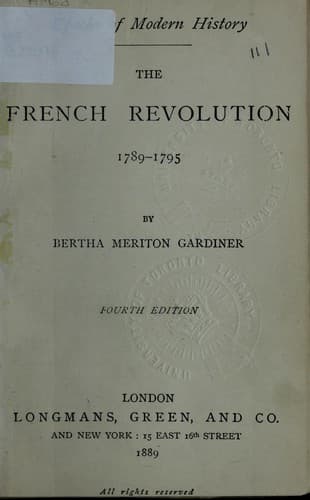
The French Revolution 1789-1795Gardiner, Bertha Meriton
History
The French Revolution 1789-1795
Gardiner, Bertha Meriton
France -- History -- Revolution, 1789-1799
The second section comprised deputies of all three orders. They were
defenders of individual liberty and parliamentary control, but were
bitterly opposed to the establishment of democratic institutions. They
did not believe in the endurance of monarchy without an aristocracy
and aristocratical institutions, and aimed at replacing the effete
nobility by an aristocracy of wealth. For the exercise of political
rights they would have required a high property qualification; and,
copying the constitution of the English parliament, would have
established a legislature composed of two houses, in both of which the
landed interest was to predominate. They detested insurrection as a
weapon, and were thoroughly alive to the danger in which since July 14
all authorities stood--of falling beneath the sway of mob violence.
The restoration of order was, from their point of view, the matter
of first moment, and they accordingly desired that the Assembly, in
place of discussing constitutional questions, should at once turn its
attention to the reform of the taxes and to other remedial laws, and
that at the same time ministers should be empowered to use coercive
measures for the punishment of rioters and the maintenance of the
public tranquillity. The upholders of these views, who sat next the
reactionary right, were but a small minority. Their most able speakers
were two deputies of the Third Estate--Mounier and Malouet, and two
nobles--Clermont-Tonnerre and Lally-Tollendal.
♦The Centre and Left.♦
The third and most numerous section, forming the centre and left of the
Assembly, consisted of curés and deputies of the Third Estate, with a
sprinkling of nobles and upper clergy. Though considerable differences
of opinion prevailed in this body of seven to eight hundred men, two
sentiments were common to all--passion for equality and desire for
self-government. Hence no schemes calculated to vest power in the
hands of large landed proprietors found favour with them. They were
not, however, pure democrats, nor by sentiment republicans. Their real
aim was government by the middle classes. To monarchy as a form of
government they were not only attached, but regarded its maintenance
as necessary to give stability to the constitution they were about
to establish. Amongst the most prominent men on this side of the
house were Thouret, Merlin of Douai, and other eminent lawyers, the
Marquis of Mirabeau, Lafayette, the Abbé Siéyès, two brothers, the
Lameths--both of them nobles and officers--and a young and eloquent
barrister, Barnave.
♦The Extreme Left.♦
Public-domain text, read in full here on John Shaqi.
Reviews
Reviews
No reviews yet
Be the first to share your thoughts on this work.
Elsewhere in the archive
Join the Discussion
Join the discussion
Sign in to leave a comment or review.
Sign InorCreate an account