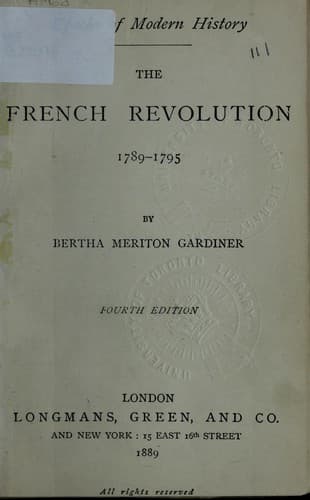
The French Revolution 1789-1795Gardiner, Bertha Meriton
History
The French Revolution 1789-1795
Gardiner, Bertha Meriton
France -- History -- Revolution, 1789-1799
The fourth section, sitting on the extreme left--which must be
distinguished from the left--was formed of a few deputies, some twenty
or thirty in all, who were pure democrats, and whose programme included
manhood suffrage, and the eligibility of all citizens to office
without property or other qualifications. A republic was their ideal
form of government, which they held alone compatible with free and
democratic institutions. At the same time they entertained no thought
of establishing such a government in France. The possibility of getting
rid of the throne had not yet suggested itself to their minds. In
the Assembly their opinions were regarded as exaggerated, and their
influence was small. Amongst them sat Pétion and Robespierre, whose
names afterwards rose into notoriety.
None of these four groups, except the last, properly speaking formed
a party of which the members ordinarily voted in a body. There was
no concerted action, no party discipline, no recognised leaders. The
galleries were often filled by an excited and noisy audience, which
interrupted debates and menaced unpopular speakers. Each deputy voted
independently, and was subject to be swayed by whatever influence at
the moment predominated--were it eloquence, enthusiasm, fear, or
prejudice. The provincial nobility followed but sullenly in the wake
of the court nobility, and on every opportunity made its hostility
manifest. Deputies belonging to the centre and left constantly voted
on opposite sides. According to the special point at issue, more or
less democratic opinions were entertained by the same person. Thus
Lafayette, although as a rule he was found in opposition to Malouet,
wished like him for the establishment of a legislature composed of
two houses, having become strongly convinced of the advantages of
that system through his affection to American institutions. The most
advanced group of the whole centre and left, headed by Barnave and the
Lameths, sat furthest left, next to Buzot and Robespierre, with whom
they not seldom voted.
♦Causes giving ascendancy to the Left.♦
Public-domain text, read in full here on John Shaqi.
Reviews
Reviews
No reviews yet
Be the first to share your thoughts on this work.
Elsewhere in the archive
Join the Discussion
Join the discussion
Sign in to leave a comment or review.
Sign InorCreate an account