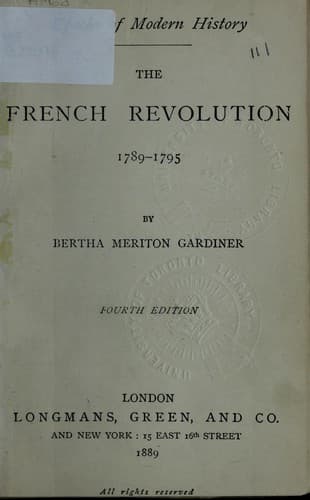
The French Revolution 1789-1795Gardiner, Bertha Meriton
History
The French Revolution 1789-1795
Gardiner, Bertha Meriton
France -- History -- Revolution, 1789-1799
incorporated the French guards, were paid and lodged in barracks. The
officers were elected by the men. Lafayette, the commander-in-chief,
was a brave and chivalrous soldier, whose enthusiasm for liberty and
equality was unmixed with motives of personal aggrandisement. He was
very popular with his troops, but his influence over them was confined
within narrow limits. The guard, composed principally of the middle
and lower middle classes, retained its character of a citizen force,
possessing a strong political bias, and capable at any time of taking a
course of its own.
♦The 6th October.♦
During the month of September the idea of going to Versailles and
bringing the royal family to Paris fermented in the minds of the poorer
inhabitants of the city. There were rumours that the King intended
flight. The hungry people believed that their sufferings were solely
due to the intrigues of reactionary nobles and ecclesiastics, and that
bread would be abundant were the King once securely established in
their midst. Whatever was proposed at Paris was known at Versailles.
Since the revolution of July, plans of retreat to Metz and other
towns had been urged on Louis. It was impossible to adopt this course
without contemplating resource to arms. The Queen was willing, but
Louis preferred to let events drift on sooner than give occasion to
his subjects to throw on him the reproach cast on Charles I., of
having roused civil war and caused the shedding of blood. Meanwhile
the policy pursued was of a piece with that which preceded the fall
of the Bastille. Paris was defied by bringing an additional force of
a thousand foreign troops, the regiment of Flanders, from Arras to
Versailles, but no further measures were taken to repel aggression.
The officers of the royal body-guard held a banquet in honour of the
new comers in the palace theatre before a large audience. The occasion
was taken to make a strongly pronounced display of royalist sentiment.
Insulting words were spoken against the Assembly; national toasts
were left undrunk; the tricolor replaced by white cockades. The King
was induced to come to the theatre, and the Queen, with the Dauphin
in her arms, went the round of the table, making gracious speeches
(October 1). Exaggerated reports of what had taken place spread through
Paris. National guards were eager to avenge the insult offered to the
tricolour, which, it was said, had been trampled under foot. Early
on the morning of October 5 many thousands of hungry women began a
march from Paris to Versailles, stopping and forcing all of their own
sex whom they met on the way to accompany them. Bands of men soon
followed, and the national guards, in place of opposing the movement,
compelled Lafayette to march at their head after the mob. There was
heavy rain all day, and the women on their arrival at Versailles were
weary, fasting, and wet. They surrounded the palace, and broke into
the hall of the Assembly, shouting, in reply to the speeches of the
Public-domain text, read in full here on John Shaqi.
Reviews
Reviews
No reviews yet
Be the first to share your thoughts on this work.
Elsewhere in the archive
Join the Discussion
Join the discussion
Sign in to leave a comment or review.
Sign InorCreate an account