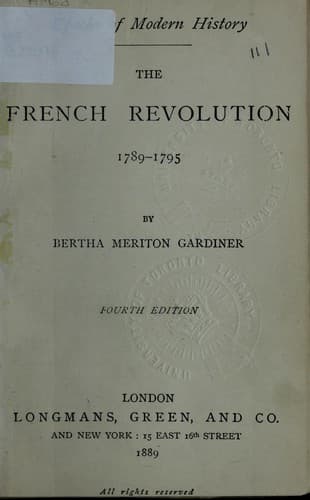
The French Revolution 1789-1795Gardiner, Bertha Meriton
History
The French Revolution 1789-1795
Gardiner, Bertha Meriton
France -- History -- Revolution, 1789-1799
Debates on the form to be given to the new legislature followed the
adoption of the Declaration of the rights of man. The proposal that
there should be two houses was negatived by 499 against 89 votes. The
new legislature was to meet every two years. The question whether the
King was to have power to refuse his consent to decrees or exercise
a so-called veto upon them was the cause of great excitement both
at Versailles and Paris. Ultra-democratic agitators and journalists
declared that to allow the King a share in the legislative power was
to wrong the sovereignty of the nation. The relation existing between
Louis and the Assembly was thoroughly false. The deputies of the
centre and left were eager to avoid coming into collision with him,
but were aware that he was only following by compulsion in their wake.
On the ground that the nation was entitled to choose its own form of
government, they took for granted that Louis must sanction without
question or criticism all constitutional decrees. But they dared not
trust the King, whom they excluded from any share in the formation of
the new constitution, with authority which he might hereafter employ to
subvert it. On the question of the veto a compromise was adopted, and
the King empowered to refuse to pass the same decree during the sitting
of two consecutive legislatures (September 20).
♦Scarcity of bread.♦
While the Assembly was engaged in discussion on the rights of man,
all the causes which had been productive of crime and riot were still
at work. The price of bread remained high after the harvest. This was
due in part to deficiency in the crops, but much more generally to
interference with the corn trade. The Assembly, acting in accordance
with the free trade theories of the Economists, annulled all
regulations impeding the free circulation of corn and flour. But the
people, ignorant, distrustful and fierce, used the power that was in
their hands to carry out the old system more methodically, threatening
municipal officers with personal violence unless they took measures to
insure that markets were well supplied. Pillage of corn on transit and
purchases made by public bodies stopped ordinary trade, and produced an
appearance of scarcity even where corn was plentiful. In every large
town bread was sold under cost, the municipalities making good the
loss to the bakers. To provision Paris, convoys of flour were brought
into the town under military escort; large purchases of foreign corn
were made, the Government supplying funds; and by these means bread
was sold at about three halfpence the pound. But bread, if cheap, was
scarce. Purchasers stood for hours in long ranks or _queues_ at the
bakers’ doors, and those who came last often left empty-handed. On the
municipality and the national guard devolved the task of maintaining
order. The national guard formed an organised police force. Most
of those who served were volunteers, but 6,000, with whom had been
Public-domain text, read in full here on John Shaqi.
Reviews
Reviews
No reviews yet
Be the first to share your thoughts on this work.
Elsewhere in the archive
Join the Discussion
Join the discussion
Sign in to leave a comment or review.
Sign InorCreate an account