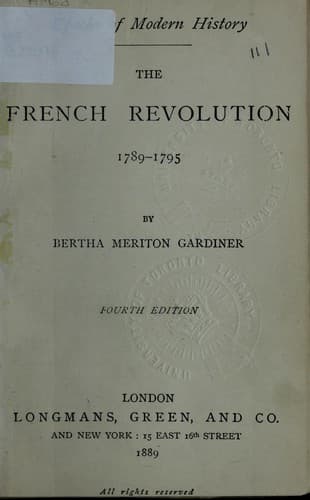
The French Revolution 1789-1795Gardiner, Bertha Meriton
History
The French Revolution 1789-1795
Gardiner, Bertha Meriton
France -- History -- Revolution, 1789-1799
in the hands of the bishops, who had been driven by the loss of their
revenues into unappeasable hostility to the revolution, an arm of which
they were not slow to avail themselves, and by which they created a
schism within the Church (November 27). This oath engaged the taker
to be faithful to the nation, the law, and the King, and to maintain
the constitution. The object which the Assembly had in view was to
replace bishops who refused to take part in carrying out the new laws
by men attached to the revolution. The fact, however, that the oath
might be interpreted to imply acknowledgment of the lawfulness of
the Civil Constitution of the Clergy, the provisions of which were
inconsistent with the Papal system, was left out of account. The Pope
declared that those who had taken it were schismatics, and cut off from
communion with the Church. Passive acceptance of the civil constitution
was, therefore, no longer possible to the curés. Of 138 bishops and
archbishops only four took the oath, and two-thirds of the secular
clergy refused it. Many members of the regular orders, however, took
it, so that in the end about 60,000 ecclesiastics, or half of the
clergy of France, accepted the new arrangements.
By the imposition of this oath discord was aroused in every department.
The Assembly granted nonjurors a pension, and allowed them to
officiate in parish churches. The result was that in two-thirds of
the parishes of France there were two ministers, nominally of the
same persuasion, struggling, the one to gain, the other to maintain,
influence over the flock. The constitutional priest represented the
nonjuror, or former incumbent, as a plotter against the laws and the
constitution; the latter represented the intruder as a schismatic,
incapable of administering any sacrament, so that persons married or
children baptised by him were in reality neither married nor baptised.
Here nonjurors were regarded as enemies to the State; there the
constitutional clergy as enemies to religion; and whichever side
was the stronger proceeded to acts of violence against the other.
Generally, in the north of France, the nonjurors had comparatively
small influence; and it was only in certain provinces, where they had
the support of the peasantry--in Poitou, Auvergne, Alsace, and parts
of Artois, Franche-Comté, Champagne, Languedoc, and Bretagne--that any
large portion of the population exhibited zeal in their behalf.
Public-domain text, read in full here on John Shaqi.
Reviews
Reviews
No reviews yet
Be the first to share your thoughts on this work.
Elsewhere in the archive
Join the Discussion
Join the discussion
Sign in to leave a comment or review.
Sign InorCreate an account