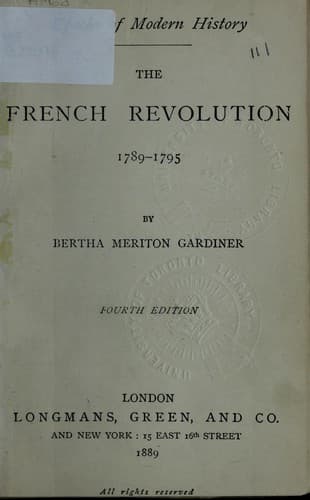
The French Revolution 1789-1795Gardiner, Bertha Meriton
History
The French Revolution 1789-1795
Gardiner, Bertha Meriton
France -- History -- Revolution, 1789-1799
to fight to the last extremity in defence of its independence, and the
expectation that the principles of the revolution would spread rapidly
amongst other nations, and cause them to rise against their rulers,
led the Girondists to entertain no doubt of the success of their arms.
‘Let us tell Europe,’ exclaimed a fiery orator, Isnard, ‘that if
cabinets engage kings in a war against peoples, we will engage peoples
in a war against kings.’ Of the constitutionalists few cared to avoid
a rupture. The majority looked forward to war as a means of insuring
the ascendancy of their own party, and of bringing into existence
a powerful army under Lafayette’s command. There was no difficulty
in finding a ground of quarrel with Leopold either as Emperor or as
King of Hungary and Bohemia. The Assembly threatened to attack the
empire unless the bands of emigrants on the frontier were dispersed.
Afterwards, shifting its ground, it accused Leopold of having broken
the treaty of 1756 between France and Austria, and declared that a
refusal to renounce all treaties directed against the independence of
the French nation--in other words, his understanding with the King of
Prussia--would be held tantamount to a declaration of war (January 25,
1792). This hostile attitude of the Assembly hastened the conclusion of
a defensive alliance between Austria and Prussia; after which Leopold,
no longer caring to delay hostilities, added fuel to the flame by
claiming a right of interference in the internal affairs of France,
and by accusing the Assembly of being under the illegal ascendancy of
republicans and Jacobins.
The outbreak of war might probably have been postponed, but it could
hardly have been definitely averted. The doctrines of social and
political equality announced by the French revolutionists were not, as
were the arguments from law and precedent which had in the seventeenth
century risen to the surface in the English Long Parliament, adapted
merely to the country in which they arose. They were applicable to all
the states of Western Europe. Hence, they acquired all the force of a
religious propaganda. As in the sixteenth century men were not asked
whether they were Germans or Frenchmen, but whether they were Catholics
or Protestants, so now they would be first asked whether they were
on the side of the revolutionary opinions or not. Before that great
division of opinions all national antagonisms sank into comparative
insignificance. The French revolutionist could not long avoid being
carried away by a fierce desire to give effectual aid to his brother
revolutionist abroad, and the German or English anti-revolutionist
could not long keep his hands out of the fray whilst the classes in
France with whom he warmly sympathised were being borne down and
oppressed.
♦Declaration of War.♦
Public-domain text, read in full here on John Shaqi.
Reviews
Reviews
No reviews yet
Be the first to share your thoughts on this work.
Elsewhere in the archive
Join the Discussion
Join the discussion
Sign in to leave a comment or review.
Sign InorCreate an account