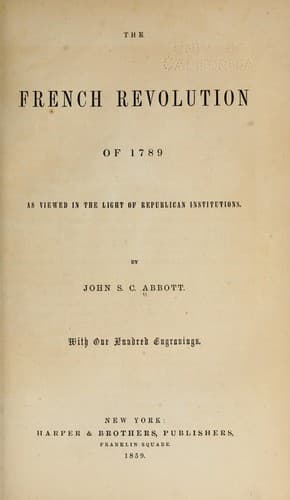
The French Revolution of 1789, as Viewed in the Light of Republican InstitutionsAbbott, John S. C. (John Stevens Cabot)
History
The French Revolution of 1789, as Viewed in the Light of Republican Institutions
Abbott, John S. C. (John Stevens Cabot)
France -- History -- Revolution, 1789-1799
This state of things had secured perfect reconciliation between the
court and the aristocracy. The lines were now distinctly drawn; the
king, nobles, and clergy on one side, the people on the other. The
excitement in Paris during this protracted conflict was very great. A
large wooden tent was erected in the garden of the Palais Royal, where
a crowd was almost constantly gathered to receive the news brought by
couriers from Versailles. At every street corner, in every café, the
subject was discussed. Almost every hour produced a pamphlet. "There
were thirteen issued to-day," writes Arthur Young, "sixteen yesterday,
ninety-two last week." In the mean time the court was concentrating the
troops from all parts of the kingdom around Paris and Versailles, and a
hundred pieces of field artillery menaced the two cities.
It was now necessary to give the Assembly a name, a name which should
define its functions. The assumption that they were the nation would
be bold and defiant. The admission that they were but a _branch_ of
the national representation would be paralyzing. The Assembly was
impelled to prompt and decisive action by the apprehension, universally
entertained, that the court might employ the army, now assembled in
such force, to arrest the principal deputies, dissolve the States, and,
if the people of Paris manifested any opposition, to surround the city
and starve them into subjection. Sièyes, in a celebrated pamphlet which
he had issued to prepare the public mind for this movement, had said,
"The Third Estate alone, they affirm, can not form the States-General.
Well! so much the better; it shall compose a National Assembly." A body
which, by universal admission represented ninety-six hundredths of the
nation, might with propriety take the name of National.[110]
Upon the morning of the 17th of June, after a long and animated
discussion of the preceding day, the Commons met to decide this
all-important question. The king, the court, and the aristocracy
were greatly alarmed. If this bold, resolute body were the _nation_,
what were they? Nothing. The people were intensely excited and
animated. Thousands in every conceivable vehicle flocked out from
Paris to Versailles. The galleries of the vast hall, rising like an
amphitheatre, were crowded to their utmost capacity. The building
was surrounded and the broad avenues of Versailles thronged with the
excited yet orderly multitude.
Public-domain text, read in full here on John Shaqi.
Reviews
Reviews
No reviews yet
Be the first to share your thoughts on this work.
Elsewhere in the archive
Join the Discussion
Join the discussion
Sign in to leave a comment or review.
Sign InorCreate an account