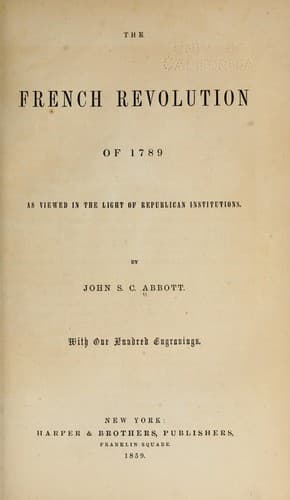
The French Revolution of 1789, as Viewed in the Light of Republican InstitutionsAbbott, John S. C. (John Stevens Cabot)
History
The French Revolution of 1789, as Viewed in the Light of Republican Institutions
Abbott, John S. C. (John Stevens Cabot)
France -- History -- Revolution, 1789-1799
At an early hour the Assembly adjourned. Couriers from the hall
hastened to expectant Paris with the glad tidings. The most fervid
imagination can not conceive the joyful enthusiasm which the
intelligence excited in the metropolis and throughout France. The king
and his court were at this time a few miles from Versailles, in the
Palace of Marly. The clergy and the nobles, in consternation, sent a
committee of their most prominent members to implore the interposition
of the royal power.[111] But the king had not sufficient nerve for so
decisive an act. It was urged that the nobility and the clergy should
immediately combine in forming a united body which should constitute
an upper house; and thus naturally the kingdom would have fallen into
a monarchy like that of England, with its House of Lords and its House
of Commons. This would have been a most salutary reform, and would have
prepared the way for the gradual and safe advance of the nation from
servitude to freedom. But, with madness almost inconceivable, the high
nobility with contempt repelled all idea of union.[112] They deemed it
a degradation to form a permanent association with the lower clergy
and with men who had been within a few centuries ennobled by a decree
of the king. Thus the formation of two separate chambers was rendered
impossible by the folly of those very men whose existence depended
upon it. Thus all was confusion and dismay with the nobles and the
clergy, while unanimity and vigor pervaded every movement of the
Assembly.[113]
In this state of affairs a large proportion of the clergy, composing
nearly all the parish ministers, were in favor of uniting with the
Assembly. The Duke of Orleans also, among the nobility, led a small
minority of the nobles in advocacy of the same measure. But the court
generally entreated the king immediately to dissolve the Assembly,
by violence if needful. The popular excitement in Paris and in
Versailles became intense. The only hope of the people was in the
Assembly. Its dissolution left them hopeless and in despair. The king
was vacillating, intensely anxious to crush the popular movement,
now become so formidable, but still fearing to adopt those energetic
measures by which alone it could be accomplished. He at length decided,
in accordance with that system of folly with which the court seems to
have been inspired, to resort to the very worst measure which could
have been adopted. On Friday the 17th of June the majority of the
clergy, consisting of a few prelates and about one hundred and forty
curates, resolved to withdraw from the dignitaries of the Church and
unite with the people, in the Assembly, the next day. The prospect of
such an accession to the popular branch struck consternation into the
ranks of the privileged classes. A delegation of bishops and nobles in
the night hastened to the king at Marly, and persuaded him to interfere
to prevent the junction.
Public-domain text, read in full here on John Shaqi.
Reviews
Reviews
No reviews yet
Be the first to share your thoughts on this work.
Elsewhere in the archive
Join the Discussion
Join the discussion
Sign in to leave a comment or review.
Sign InorCreate an account