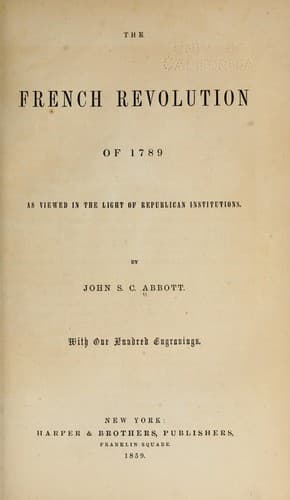
The French Revolution of 1789, as Viewed in the Light of Republican InstitutionsAbbott, John S. C. (John Stevens Cabot)
History
The French Revolution of 1789, as Viewed in the Light of Republican Institutions
Abbott, John S. C. (John Stevens Cabot)
France -- History -- Revolution, 1789-1799
[Footnote 126: Mr. Alison strangely says that "These decrees contained
the whole elements of rational freedom, abolished pecuniary privileges,
regulated the expenses of the royal household, secured the liberty of
the press, regulated the criminal code, and the personal freedom of the
subject."--_Alison, Hist. of Europe_, vol. i., p. 74. The French people
did not think so. See Michelet's indignant rejection of the mockery of
these decrees.--_Mich., Hist. Fr. Rev._, vol. i., p. 115. M. Rabaud de
St. Etienne, member of the Assembly, writes, "In these benefits which
the king was thus promising to the nation, no mention was made either
of the constitution so much desired, or of the participation of the
States-General in all acts of legislation, or of the responsibility
of ministers, or of the liberty of the press; and almost every thing
which constitutes civil liberty was passed over in total silence.
Nevertheless, the pretensions of the privileged orders were maintained,
the despotism of the ruler was sanctioned, and the States-General were
abased and subject to his power."--_Hist. of Rev. of Fr._, vol. i., p.
56.
The Marquis of Ferrières writes, "The hall was surrounded by soldiers
and by guards. Every thing about the throne was silent and melancholy.
The declaration itself satisfied no one; and the king spoke rather
like a despot who commanded than a monarch who discussed with the
representatives of his people the interests of a great nation."]
CHAPTER XI.
REVOLUTIONARY MEASURES.
Speech of Mirabeau.--Approach of the Soldiers and Peril of the
Assembly.--Elation of the Queen.--Triumph of Necker.--Embarrassment
of the Bishops and the Nobles.--Letter of the King.--The Bishops and
Nobles join the Assembly.--Desperate Resolve of the Nobles.--The
Troops sympathizing with the People.
As the king, followed by the nobles and the clergy, left the hall, the
Commons remained in their seats. The crisis had now arrived. There was
no alternative but resistance or submission, rebellion or servitude.
For a moment there was an entire silence. But the spirit of indomitable
determination glowed on every cheek. Mirabeau was the first to rise.
In a few of those impassioned sentences, which pealed over France like
clarion notes, he exclaimed,
"Why this dictatorial language, this train of arms, this violation
of the national sanctuary? Who is it who gives commands to us--to us
to whom alone twenty-five millions of men are looking for happiness?
Let us arm ourselves with our legislative authority, remember our
oath--that oath which does not permit us to separate until we have
established the constitution!"[127]
While he was yet speaking the Marquis of Brézé, one of the officers of
the king, perceiving that the Assembly did not retire, advanced into
the centre of the hall, and, in a loud authoritative voice, a voice
at whose command nearly fifty thousand troops were ready to march,
demanded,
"Did you hear the commands of the king?"
Public-domain text, read in full here on John Shaqi.
Reviews
Reviews
No reviews yet
Be the first to share your thoughts on this work.
Elsewhere in the archive
Join the Discussion
Join the discussion
Sign in to leave a comment or review.
Sign InorCreate an account