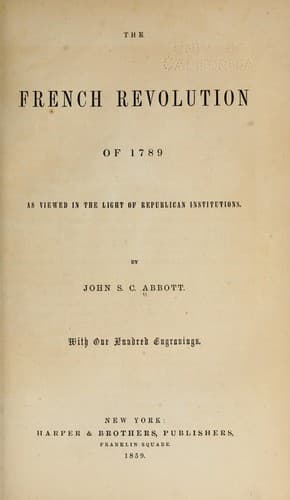
The French Revolution of 1789, as Viewed in the Light of Republican InstitutionsAbbott, John S. C. (John Stevens Cabot)
History
The French Revolution of 1789, as Viewed in the Light of Republican Institutions
Abbott, John S. C. (John Stevens Cabot)
France -- History -- Revolution, 1789-1799
De Launey, from the summit of his towers, had for many hours heard the
roar of the insurgent city. As he now saw the black mass of countless
thousands approaching, he turned pale and trembled. All the cannon,
loaded with grapeshot, were thrust out of the port-holes, and several
cart-loads of paving-stones, cannon-balls, and old iron had been
conveyed to the tops of the towers to be thrown down to crush the
assailants. Twelve large rampart guns, charged heavily with grape,
guarded the only entrance. These were manned by thirty-two Swiss
soldiers who would have no scruples in firing upon Frenchmen. The
eighty-two French soldiers who composed the remainder of the garrison
were placed upon the towers, and at distant posts, where they could act
efficiently without being brought so immediately into conflict with the
attacking party.
A man of very fearless and determined character, M. Thuriot, was
sent by the electors at the Hôtel de Ville to summon the Bastille
to surrender. The draw-bridge was lowered, and he was admitted. The
governor received him at the head of his staff.
"I summon you," said Thuriot, "in the name of the people, in the name
of honor, and of our native land."
The governor, who was every moment expecting the arrival of troops to
disperse the crowd, refused to surrender the fortress, but replied that
he was ready to give his oath that he would not fire upon the people,
if they did not fire upon him. After a long and exciting interview,
Thuriot came forth to those at the Hôtel de Ville who had sent him.
He had hardly emerged from the massive portals, and crossed the
draw-bridge of the moat, which was immediately raised behind him, ere
the people commenced the attack. A scene of confusion and uproar ensued
which can not be described. A hundred thousand men, filling all the
streets and alleys which opened upon the Bastille, crowding all the
windows and house-tops of the adjacent buildings, kept up an incessant
firing, harmlessly flattening their bullets against walls of stone
forty feet thick and one hundred feet high.[168]
The French soldiers within the garrison were reluctant to fire upon
their relatives and friends. But the Swiss, obedient to authority,
opened a deadly fire of bullets and grapeshot upon the crowd. While
the battle was raging an intercepted letter was brought to the Hôtel
de Ville, in which Bensenval, commandant of the troops in the Field of
Mars, exhorted De Launey to remain firm, assuring him that he would
soon come with succor.[169] But, fortunately for the people, even these
foreign troops refused to march for the protection of the Bastille.
The French Guards now broke from their barracks, and, led by their
subaltern officers, came with two pieces of artillery in formidable
array to join the people. They were received with thunders of applause
which drowned even the roar of the battle. Energetically they opened
their batteries upon the fortress, but their balls rebounded harmless
from the impregnable rock.
Public-domain text, read in full here on John Shaqi.
Reviews
Reviews
No reviews yet
Be the first to share your thoughts on this work.
Elsewhere in the archive
Join the Discussion
Join the discussion
Sign in to leave a comment or review.
Sign InorCreate an account