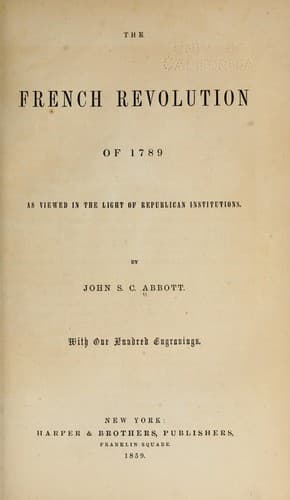
The French Revolution of 1789, as Viewed in the Light of Republican InstitutionsAbbott, John S. C. (John Stevens Cabot)
History
The French Revolution of 1789, as Viewed in the Light of Republican Institutions
Abbott, John S. C. (John Stevens Cabot)
France -- History -- Revolution, 1789-1799
At the Place Louis XV. the deputies left their carriages and were
conducted through the garden of the Tuileries, greeted by the music
of martial bands, to the vestibule of the palace. There they were met
by a committee of the municipality, with one of the clergy, the Abbé
Fauchet, at its head, who accompanied them to the Hôtel de Ville.
La Fayette addressed the electors, informing them of the king's
speech, and describing the monarch's return to his palace in the
midst of the National Assembly and of the people of Versailles,
"protected by their love and their inviolable fidelity." Lally
Tollendal, who was remarkable for his eloquence, then addressed the
electors and the assembled multitude. He spoke of the king, whom he
loved, in the highest terms of eulogy, and in a strain so persuasive
and spirit-stirring that he was immediately crowned with a wreath of
flowers, and, in a tumult of transport, was carried in triumph to the
window to receive the applause of the thousands who filled the streets.
Love for the king seemed to be an instinct with the populace. Shouts
of "Vive le Roi!" rose from the vast assembly, which were reverberated
from street to street through all the thronged thoroughfares of the
metropolis.
The king had authorized the establishment of the National Guard, but
the guard was yet without a commander-in-chief. The government of
Paris also, by the death of Flesselles, had no head. There was in the
hall of the Assembly a bust of La Fayette which had been presented
by the United States to the city of Paris. It stood by the side of
the bust of Washington. As the momentous question was discussed, who
should be intrusted with the command of the National Guard, a body
which now numbered hundreds of thousands and was spread all over the
kingdom, Moreau de St. Mèry, Chairman of the Municipality, rose, and,
without uttering a word, silently pointed to the bust of La Fayette.
The gesture was decisive. A general shout of acclaim filled the room.
He who had fought the battles of liberty in America was thus intrusted
with the command of the citizen-soldiery of France. M. Bailly was
then chosen successor of Flesselles, not with the title of Prévôt des
Marchands, but with the more comprehensive one of Mayor of Paris.
On the 27th of September the banners of the National Guard, each one of
which had been previously consecrated in the church of its district,
were all taken to the Cathedral of Nôtre Dame, and there, with the
utmost pomp of civil, military, and religious ceremonies, were
consecrated to the service of God and the nation.
[Illustration: BLESSING THE BANNERS.]
FOOTNOTES:
[Footnote 174: It has not subsequently appeared that there was any
conclusive evidence of the existence of this letter.]
[Footnote 175: Histoire Des Montagnards, par Alphonse Esquiros, p. 17.]
Public-domain text, read in full here on John Shaqi.
Reviews
Reviews
No reviews yet
Be the first to share your thoughts on this work.
Elsewhere in the archive
Join the Discussion
Join the discussion
Sign in to leave a comment or review.
Sign InorCreate an account