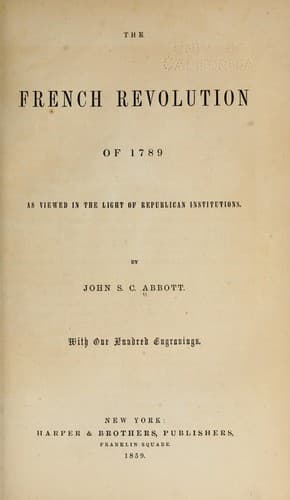
The French Revolution of 1789, as Viewed in the Light of Republican InstitutionsAbbott, John S. C. (John Stevens Cabot)
History
The French Revolution of 1789, as Viewed in the Light of Republican Institutions
Abbott, John S. C. (John Stevens Cabot)
France -- History -- Revolution, 1789-1799
As the king returned through the vast throng to Versailles, the tide of
enthusiasm set strongly in his favor. Shouts of "Vive le Roi!" almost
deafened his ears. The populace bore him in their arms to his chariot.
A woman threw herself upon his neck and wept with joy. Men ran from the
houses with goblets of wine for his postillions and his suite. A few
words from his lips then would have re-echoed through the crowd, and
might have saved the monarchy. But Louis was a man of feeble intellect,
and of no tact whatever. He was pleased with the homage which was
spontaneously offered him, and, stolid in his immense corpulence, sat
lolling in his chariot, with a good-natured smile upon his face, but
uttered not a word. It was after nine o'clock in the evening when
he returned to the palace at Versailles. The queen and her children
met him on the stairs, and, convulsively weeping, threw themselves
into his arms. Clinging together, they ascended to the saloon. There
the queen caught sight of the tricolored cockade, which the king had
forgotten to remove from his hat. The queen recoiled, and looking upon
it contemptuously, exclaimed, "I did not think that I had married a
plebeian." The good-natured king, however, forgot all his humiliations
in his safe return, and congratulated himself that no violence had been
excited.
"Happily," he said, "no blood has been shed; and it is my firm
determination that never shall a drop of French blood be spilled by my
order."[185]
While these scenes were transpiring on this the 17th of July, the Count
d'Artois, second brother of the king, the Condés, the Polignacs, and
most of the other leaders of the aristocratic party fled from France.
The conspiracy they had formed had failed, the nation had risen against
them, and no reliance could be placed on the vacillating king. Their
only hope now was to summon the combined energies of foreign despotisms
to arrest the progress of that liberty in France which alike threatened
all their thrones. The palace was now forsaken and gloomy as a tomb.
For three days the king sadly paced the deserted halls, with none of
his old friends to cheer or counsel him but Bensenval and Montmorin.
His servants, conscious that he had fallen from his kingly power,
became careless even to insolence. Even the French Guard mounted guard
at Versailles only on orders received from the Electors at Paris.[186]
On the 19th Bensenval presented an order for the king to sign. A
footman entered the cabinet, and looked over the king's shoulder to see
what he was writing. Louis, amazed at such unparalleled effrontery,
seized the tongs to break the head of the miscreant. Bensenval
interposed to prevent the undignified blow. The king clasped the
hand of his friend, and, bursting into tears, thanked him for the
interposition. Thus low had fallen the descendant of Louis XIV. in his
own palace at Versailles.[187]
Public-domain text, read in full here on John Shaqi.
Reviews
Reviews
No reviews yet
Be the first to share your thoughts on this work.
Elsewhere in the archive
Join the Discussion
Join the discussion
Sign in to leave a comment or review.
Sign InorCreate an account