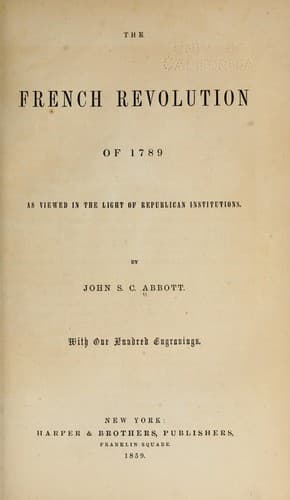
The French Revolution of 1789, as Viewed in the Light of Republican InstitutionsAbbott, John S. C. (John Stevens Cabot)
History
The French Revolution of 1789, as Viewed in the Light of Republican Institutions
Abbott, John S. C. (John Stevens Cabot)
France -- History -- Revolution, 1789-1799
The rage of the people, during these days of distress, was particularly
directed against those whom they deemed monopolists, who were accused
of keeping from the market the very sources of life. The sufferings of
the people and their desperation were so intense that it was necessary
to send military bands from the city of Paris to convoy provisions
through the famishing districts. The peasants, who saw their children
actually gasping and dying of hunger, would attack the convoys with
the ferocity of wolves, and, though it seemed absolutely necessary to
resist them even unto death, no one could severely blame them.
There were two men, M. Foulon and M. Berthier, who were conspicuous
members of the court, and who had both been very active in their
hostility to the popular cause. Upon the overthrow of the Necker
ministry, these men were called into the new ministry, antagonistic to
the people. It was reported that M. Foulon, who was the father-in-law
of M. Berthier, had frequently said, "If the _people_ are hungry, let
them eat grass. It is good enough for _them_; my horses eat it."[189]
He is also stated to have uttered the terrible threat, "France must be
mowed as we mow a meadow." He was reputed to be a man of great wealth,
and had long been execrated by the people. These brutal remarks,
which have never been proved against him, but which were universally
believed, and which were in entire harmony with his established
character, excited the wrath of the people to the highest pitch.[190]
Berthier, his son-in-law, even the Royalists confess to have been a
very hard-hearted man, unscrupulous and grasping.[191] Though fifty
years of age he was an atrocious libertine, and seemed to exult in the
opportunity of making war upon the Parisians, by whom he was detested.
He showed "a diabolical activity," says Michelet, "in collecting arms,
troops, every thing together, and in manufacturing cartridges. If Paris
was not laid waste with fire and sword it was not his fault."[192]
Both Berthier and Foulon were now at the mercy of the people. Neither
the court nor the royal army had any power to protect them, and murmurs
loud and deep fell upon their ears. Berthier attempted to escape from
France to join the Royalists who had already emigrated. Fleeing by
night and hiding by day, in four nights he reached as far as Soissons.
Foulon adopted the stratagem of a pretended death. He spread the report
that he had died suddenly of apoplexy. He was buried by proxy with
great pomp, one of his servants having by chance died at the right
moment. He then repaired to the house of a friend, where he concealed
himself. He would have been forgotten had he not been so utterly
execrated by all France. Those who knew him best hated him the worst.
His servants and vassals detected the fraud, and, hunting him out,
found him in the park of his friend.
"You wanted to give _us_ hay," said they; "you shall eat some yourself."
Public-domain text, read in full here on John Shaqi.
Reviews
Reviews
No reviews yet
Be the first to share your thoughts on this work.
Elsewhere in the archive
Join the Discussion
Join the discussion
Sign in to leave a comment or review.
Sign InorCreate an account