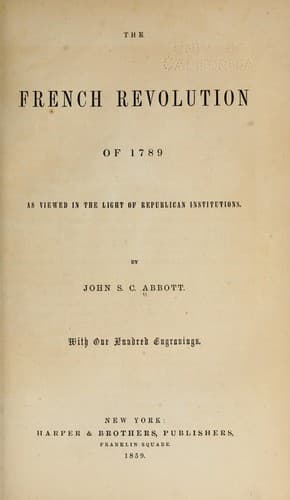
The French Revolution of 1789, as Viewed in the Light of Republican InstitutionsAbbott, John S. C. (John Stevens Cabot)
History
The French Revolution of 1789, as Viewed in the Light of Republican Institutions
Abbott, John S. C. (John Stevens Cabot)
France -- History -- Revolution, 1789-1799
[Footnote 182: The Parliamentary History, vol. ii., p. 130, records
that 100 deputies accompanied the king; Thiers states 200; Louis
Blanc, 240; Michelet, 300 or 400. M. Rabaud de St. Etienne, a member
of the Assembly, says that the whole body of the deputies accompanied
the king; and M. Ant. Fantin Desodoards, an eye-witness, writes,
"L'Assemblée National, entière l'accompagnait à pied dans son costume
de ceremonie," vol. i., p. 34. The probability is that 100 were chosen,
but all went.]
[Footnote 183: Michelet, vol. i., p. 173.]
[Footnote 184: Histoire de la Revolution Française, par Louis Blanc,
vol. ii., p. 420.]
[Footnote 185: Madame Campan, Memoirs, etc., ii., 59.]
[Footnote 186: Michelet, 186.]
[Footnote 187: Michelet, 175.]
[Footnote 188: "He was saved only by a deputation of the Assembly, who
showed themselves admirable for courage and humanity, risked their
lives, and preserved the man only after having begged him of the people
on their knees."--_Michelet_, p. 186.]
[Footnote 189: Bertrand de Moleville testifies that this was an
habitual expression in the mouth of Foulon.--_Annals_, vol. i., p. 347.]
[Footnote 190: "The old man (Foulon) believed, by such bravado, to
please the young military party, and recommend himself for the day he
saw approaching, when the court, wanting to strike some desperate blow,
would look out for a hardened villain."--_Michelet_, vol. ii., p. 10.]
[Footnote 191: Beaulieu's Memoirs, vol. ii., p. 10.]
[Footnote 192: "Foulon had a son-in-law after his own heart--Berthier,
the intendant of Paris, a shrewd but hard-hearted man, and
unscrupulous, as confessed by the Royalists. A libertine at the age of
fifty, in spite of his numerous family, he purchased on all sides, so
it was said, little girls twelve years of age. He knew well that he was
detested by the Parisians, and was but too happy to find an opportunity
of making war upon them."--_Michelet_, p. 184.]
[Footnote 193: An appeal to the then existing courts would have secured
the trial of Foulon by his own colleagues and accomplices, the ancient
magistrates, the only judges then empowered to act. This was evident to
all. See Michelet, p. 187.]
[Footnote 194: Deux Amis de la Liberté, vol. ii., p. 60.]
[Footnote 195: "These people," says Michelet, "whom Mirabeau termed so
well the refuse of public contempt, are as if restored to character by
punishment. The gallows becomes their apotheosis. They are now become
interesting victims--the martyrs of monarchy; their legend will go on
increasing in pathetic fictions. Mr. Burke canonized them and prayed on
their tomb."--_Historical View of the French Revolution_, p. 190.]
[Footnote 196: Sir Archibald Alison, true to his instincts as the
advocate of aristocratic usurpation, carefully conceals the character
of these men, which drew down upon them the vengeance of the mob.
Impartial history, while denouncing the ferocity of the mob, should not
conceal those outrages which roused the people to madness.]
Public-domain text, read in full here on John Shaqi.
Reviews
Reviews
No reviews yet
Be the first to share your thoughts on this work.
Elsewhere in the archive
Join the Discussion
Join the discussion
Sign in to leave a comment or review.
Sign InorCreate an account