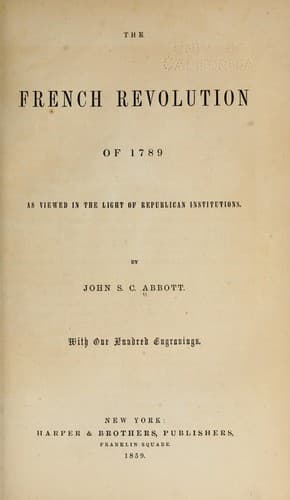
The French Revolution of 1789, as Viewed in the Light of Republican InstitutionsAbbott, John S. C. (John Stevens Cabot)
History
The French Revolution of 1789, as Viewed in the Light of Republican Institutions
Abbott, John S. C. (John Stevens Cabot)
France -- History -- Revolution, 1789-1799
"The _liberty of the press_," said Napoleon, "is not a question open
for consideration. Its prohibition under a representative government is
a gross anachronism, a downright absurdity. I therefore, on my return
from Elba, abandoned the press to all its excesses, and I am confident
that the press in no respect contributed to my downfall."
In Napoleon's last letter to his son he writes, "My son will be obliged
to allow the liberty of the press. This is a necessity in the present
day. The liberty of the press ought to become, in the hands of the
government, a powerful auxiliary in diffusing through all the most
distant corners of the empire sound doctrines and good principles. To
leave it to itself would be to fall asleep upon the brink of danger. On
the conclusion of a general peace I would have instituted a Directory
of the Press, composed of the ablest men of the country, and I would
have diffused, even to the most distant hamlet, my ideas and my
intentions."--_Las Casas._]
[Footnote 206: Mirabeau, Camille Desmoulins, Brissot, Condorcet,
Mercier, Carra, Gorsas, Marat, and Barrere, all published journals,
and some of them had a very extensive circulation. _L'Ami du Peuple_,
by Marat, was a very energetic sheet. Mirabeau printed ten thousand
copies of his _Courrier de Province_. But by far the most popular and
influential paper was the _Revolutions de Paris_, whose unknown editor
was Loustalot, a sincere, earnest, laborious young man, who died in
1792, at the age of twenty-nine. Two hundred thousand copies of his
paper were frequently sold.--_Michelet_, vol. i., p. 240.]
[Footnote 207: Miguet, p. 64.]
[Footnote 208: M. Rabaud de St. Etienne, a Christian patriot and one
of the most active members of the National Assembly, writes: "It is
possible that all the kings of Europe may form a coalition against a
humble page of writing; but, after a number of cannon-shots, and when
those potentates have destroyed three or four hundred thousand men
and laid waste twenty countries, it will not be the less true that
_men are born free and equal as to their rights, and that the nation
is the sovereign_. And it is possible that their obstinacy may have
occasioned the discovery of other truths which, but for the wrath of
those great princes, mankind would never have thought of."--_Political
Reflections_, p. 176.]
[Footnote 209: "All the wars of the European Continent against the
Revolution and against the Empire were begun by England and supported
by English gold. At last the object was attained; not only was the
ancient family restored to the throne, but France was reduced to its
original limits, its naval force destroyed, and its commerce almost
annihilated."--_Encyclopædia Americana, Art. Great Britain._]
Public-domain text, read in full here on John Shaqi.
Reviews
Reviews
No reviews yet
Be the first to share your thoughts on this work.
Elsewhere in the archive
Join the Discussion
Join the discussion
Sign in to leave a comment or review.
Sign InorCreate an account