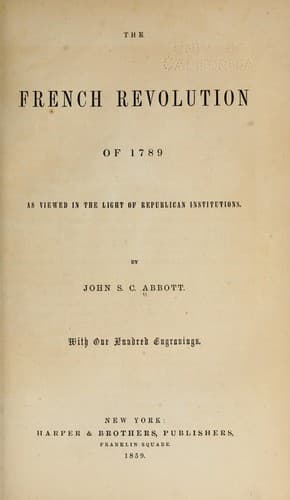
The French Revolution of 1789, as Viewed in the Light of Republican InstitutionsAbbott, John S. C. (John Stevens Cabot)
History
The French Revolution of 1789, as Viewed in the Light of Republican Institutions
Abbott, John S. C. (John Stevens Cabot)
France -- History -- Revolution, 1789-1799
The king now seriously contemplated flight, that, at a safe distance
from Paris and surrounded by chosen troops, he might dictate terms to
his people, or, if they refused, prepare, by the aid of foreign arms,
for war. About one hundred and eighty miles northeast of Paris, on the
frontiers of France, was the city of Metz. The city contained about
fifty thousand inhabitants, and its fortifications, constructed by
Vauban, were of the most extensive and formidable kind. The Marquis de
Bouille, one of the most devoted servants of the king, and subsequently
one of the most active agents in urging the foreign powers to march
against France, commanded, in garrison there, thirty thousand picked
troops, resolute Royalists, and who had been taught to regard the
popular movement with contempt.
The plan was well matured for the king to escape to Metz. There he was
to be joined by the court, the nobles with all their retainers, the
ancient parliaments of the provinces, all composed of the aristocratic
class, and by all the soldiers whom the Royalist officers could induce
to follow them to that rendezvous. Then, by the employment of all
the energies of fire and blood, France was to be brought back into
subjection to the old régime.
La Fayette knew of this plan, and yet he did not dare to divulge it to
the people, for he knew that it would provoke a fierce and terrible
outbreak. He saw the peril in which the royal family was involved,
and he wished for their protection. He saw the doom with which the
liberties of France were menaced, and the liberty for which he was
struggling was dearer to him than life. If the king had been either
a merciless despot or a reliable friend of liberty, then would La
Fayette's path of duty have been plain. But the king was an amiable,
kindly-intentioned, weak-minded, vacillating man, quite the tool of the
inexorable court.
It is difficult to conceive of a situation more embarrassing than that
in which La Fayette was now placed. He was at the head of the National
Guard and was informed of all the plots of the court. He wished to be
faithful to his sovereign, and wished also to be true to his country.
Without the connivance, or at least secret assent of La Fayette, it was
hardly possible for the king to escape.
Public-domain text, read in full here on John Shaqi.
Reviews
Reviews
No reviews yet
Be the first to share your thoughts on this work.
Elsewhere in the archive
Join the Discussion
Join the discussion
Sign in to leave a comment or review.
Sign InorCreate an account