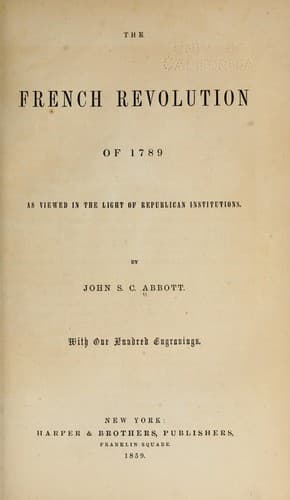
The French Revolution of 1789, as Viewed in the Light of Republican InstitutionsAbbott, John S. C. (John Stevens Cabot)
History
The French Revolution of 1789, as Viewed in the Light of Republican Institutions
Abbott, John S. C. (John Stevens Cabot)
France -- History -- Revolution, 1789-1799
[Illustration: THE ROYAL FAMILY CONVEYED TO PARIS, OCT. 6, 1789.]
It was one o'clock when the carriages containing the royal family left
Versailles.[232] The whole mob of Paris, men and women, a tumultuous,
clamorous multitude, went in advance. Following immediately the
carriages of the court came the hundred deputies, also in coaches. Then
came the National Guard. Carts laden with corn and flour, escorted by
Grenadiers, followed the immense train. None were so malignant and
merciless as the degraded women who composed so large a part of this
throng. "We shall now," they exclaimed, "have bread, for we have with
us the baker, the baker's wife, and the baker's boy."
It required seven hours for this unwieldy mass to urge its slow
progress to Paris. The king was conducted to the Hôtel de Ville, where
he was received by M. Bailly, the mayor. The royal family descended
from their carriages by torch-light, and entered the great hall,
where they were received with acclamations. After the ceremony of
reception by the municipality of Paris was over, the king and his
family were conducted to the Tuileries. The vast palace had not been
the residence of the royal family for a hundred years, and its spacious
and poorly-furnished apartments presented but a cheerless aspect. The
National Guard were stationed around the palace, and thus La Fayette
was made responsible for the safe-keeping of the person of the king.
Thus terminated the eventful days of the 5th and 6th of October, 1789.
The king was now virtually a prisoner, and the nobles could no longer
avail themselves of his name in enforcing, by the aid of foreign
armies, despotism upon France.
FOOTNOTES:
[Footnote 225: Mounier, who was strongly in favor of two chambers and
an absolute veto, in his _Report to his Constituents_, writes, in
reference to some private and friendly conferences held at this time:
"These conferences, twice renewed, were unsuccessful. They were
recommenced at the house of an American known for his abilities and his
virtues, who had both the experience and the theory of the institutions
proper for maintaining liberty. He gave an opinion in favor of my
principles."
This American was unquestionably Thomas Jefferson. He saw the peril
with which the Revolution was menaced, and that freedom needed as
strong a guard against the blind impulses of the populace as against
the encroachments of the court. Two houses might perhaps have checked
the rush to ruin, but could hardly have averted the disaster. For ages
the nobles had been "sowing the wind." It was the decree of God that
they should "reap the whirlwind." "He visiteth the iniquities of the
fathers upon the children."]
[Footnote 226: Brouillon: le Lettre de M. d'Estaing à la Reine (in
Histoire Parlementaire, vol. iii., p. 24).]
[Footnote 227: "Le ministre de la guerre multiplia les congés de
semestre, afin d'avoir un corps de volontaires royaux, composé de douze
cent cents officiers."--_Villiaumé_, p. 34.]
Public-domain text, read in full here on John Shaqi.
Reviews
Reviews
No reviews yet
Be the first to share your thoughts on this work.
Elsewhere in the archive
Join the Discussion
Join the discussion
Sign in to leave a comment or review.
Sign InorCreate an account