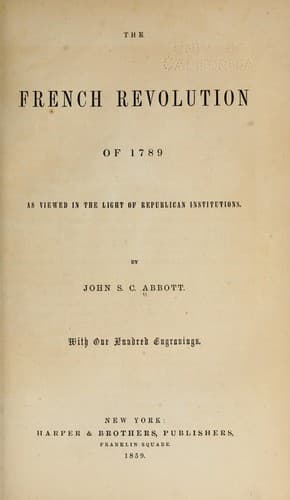
The French Revolution of 1789, as Viewed in the Light of Republican InstitutionsAbbott, John S. C. (John Stevens Cabot)
History
The French Revolution of 1789, as Viewed in the Light of Republican Institutions
Abbott, John S. C. (John Stevens Cabot)
France -- History -- Revolution, 1789-1799
The wealth of the clergy was enormous. Almsgiving, which has filled
Europe with beggary, has ever been represented by the Catholic Church
as the first act of piety. During long ages of superstition, the dying
had been induced, as an atonement for godless lives, to bequeath their
possessions to the Church, to be dispensed in charity to the people.
Thus many a wealthy sinner had obtained absolution, and thus the
ecclesiastics held endowments which comprised one fifth of the lands
of the kingdom, and were estimated at four thousand millions of francs
($800,000,000).[240]
Notwithstanding this immense opulence of the Church, nearly all the
parish pastors, the hard and faithful workers for Christianity--and
there were many such, men of true lives and of unfeigned religion--were
in the extreme of poverty. The bishops were all _nobles_, for even
Louis XVI. would elect no other. These bishops were often the most
dissolute and voluptuous of men, and reveled in incomes of a million
of francs ($250,000) a year. The working clergy, on the contrary, who
were from the people, seldom received more than two hundred francs
($40) a year. They were so poor as to be quite dependent upon their
parishioners for charity.[241]
The Assembly assumed that these treasures had been intrusted to the
Church for the benefit of the people; that the luxurious ecclesiastics,
by unfaithfulness to their trust, had forfeited the right of farther
dispensing the charity. After a very fierce strife, a motion was made
by Mirabeau, that the possessions of the Church were _at the disposal_
of the state. Many of the lower clergy voted for the resolution, and it
was adopted by a majority of 568 against 346. Forty deputies refused to
vote. This measure placed at once immense resources in the hands of the
Assembly, and necessarily exasperated tenfold the privileged classes,
and rolled a wave of alarm over the whole wide-spread domain of the
Pope. It was the signal for Catholic Europe to rise in arms against
the Revolution. As it was impossible, under the pressure of the times,
to force the sale of the enormous property of the Church without an
immense sacrifice, bonds were issued, called _assignats_, assigned or
secured on this church property.
Thus was the haughty Gallican Church deprived of its ill-gotten and
worse used wealth. The dignitaries of this Church had ever been the
most inveterate foes of popular elevation. Treasure which had been
wrested from the poor and extorted from the dying, as a gift to God for
the promotion of human virtue, they were using to forge chains for the
people, and were squandering in shameless profligacy.
Public-domain text, read in full here on John Shaqi.
Reviews
Reviews
No reviews yet
Be the first to share your thoughts on this work.
Elsewhere in the archive
Join the Discussion
Join the discussion
Sign in to leave a comment or review.
Sign InorCreate an account