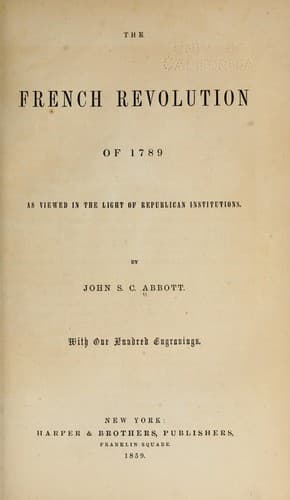
The French Revolution of 1789, as Viewed in the Light of Republican InstitutionsAbbott, John S. C. (John Stevens Cabot)
History
The French Revolution of 1789, as Viewed in the Light of Republican Institutions
Abbott, John S. C. (John Stevens Cabot)
France -- History -- Revolution, 1789-1799
[Footnote 243: Some curious facts were elicited during the progress
of this discussion respecting the manner in which a portion of the
vast revenues of the Church had been obtained. The clergy of Condom
promised the simple, kind-hearted peasants, in consideration for a
large quantity of grain, that they would every year conduct two hundred
and fifty souls from purgatory directly to Paradise. In some places a
regular tariff of prices had been established for the pardon of crimes.
Absolution for incest could be purchased for one dollar, arson required
one dollar and a quarter, parricide one dollar, and absolution could be
obtained for all sins united for about sixteen dollars. These prices
seem very moderate. But it must be remembered that the peasants were
_excessively_ poor, and could not, even to escape from purgatory, pay
large sums.--_Villiaumé_, p. 52.]
[Footnote 244: Histoire des Montagnards, par Alphonse Esquiros, p. 25.]
[Footnote 245: In the Faubourg St. Antoine, which contained a
population of thirty thousand, it is said that there were but two
hundred _active citizens_. Marat, in his addresses to the "unfortunate
citizens of the faubourgs," urged them to vote, notwithstanding the
decree of the Assembly. "No power under the sun," said he, "can deprive
you of the right of suffrage, which is inherent in society itself."]
[Footnote 246: The price of salt immediately fell from fourteen sous a
pound to less than one sou.--_Villiaumé._]
[Footnote 247: It was not until the month of March, 1792, that the
guillotine was first used,]
[Footnote 248: "The government of the Revolution was rapidly becoming
established. The Assembly had given to the new régime its monarch,
its national representation, its territorial division, its armed
force, its municipal and administrative power, its popular tribunals,
its currency, its clergy; it had made an arrangement with respect
to its debt, and had found means to reconstruct property without
injustice."--_Miguet_, p. 87.]
[Footnote 249: Michelet's French Revolution, p. 358.]
[Footnote 250: "What was the National Assembly doing at this
time in Paris? Its more than Christian meekness is a surprising
spectacle."--_Michelet_, p. 365.]
CHAPTER XIX.
THE KING ACCEPTS THE CONSTITUTION.
The King visits the Assembly.--His Speech.--The Priests rouse
the Populace.--The King's Salary.--Petition of Talma.--Views
of Napoleon.--Condemnation and Execution of the Marquis of
Favrus.--Spirit of the New Constitution.--National Jubilee.--The
Queen sympathizes with the Popular Movement.--Writings of Edmund
Burke.
Public-domain text, read in full here on John Shaqi.
Reviews
Reviews
No reviews yet
Be the first to share your thoughts on this work.
Elsewhere in the archive
Join the Discussion
Join the discussion
Sign in to leave a comment or review.
Sign InorCreate an account