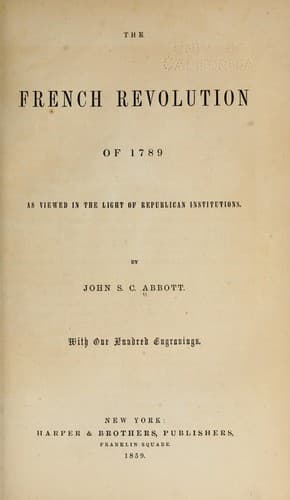
The French Revolution of 1789, as Viewed in the Light of Republican InstitutionsAbbott, John S. C. (John Stevens Cabot)
History
The French Revolution of 1789, as Viewed in the Light of Republican Institutions
Abbott, John S. C. (John Stevens Cabot)
France -- History -- Revolution, 1789-1799
Free principles had been infused into the government; _lettres de
cachet_, the most infamous instruments of oppression the world has ever
known, abolished; feudal impediments and oppressions of every kind
removed; the right of suffrage established and made almost universal;
the offices of honor and emolument in the state thrown open to merit,
with but the slightest limitations; religious liberty proclaimed, the
Protestant, the Jew, the negro, and the play-actor enfranchised; law
made uniform, criminal jurisprudence reformed, monasteries, those
haunts of indolence and vice, abolished, and the military force of the
country intrusted to the citizens of the country. Such a transformation
from the slavery, corruption, and horror of the old régime was
translation from the dungeon to the blaze of day. All this was done
almost without violence. The court here and there shot down a few
hundred, some chateaux were burned, and there were a few acts of mob
violence; but that a nation of twenty millions of people should have
been able to accomplish so vast a change so bloodlessly must ever be a
marvel.
But the armies of aristocratic opposition were gathering to crush this
liberty, which threatened to spread to other states. Despotic Europe
combined, and with all her accumulated armies fell upon the people of
France. The recently emancipated people fought to protect themselves
from new chains with all the blind fury and ferocity of despair. Then
ensued scenes of blood and woes which appalled the world.[254]
The French people, unconscious of the terrific storm which was
gathering, prepared for a great national jubilee. It was to be held
on the 14th of July, the anniversary of the fall of the Bastille.
All France was to be represented at the festival. The Field of Mars,
a vast parade-ground in Paris, a mile in length and half a mile in
width, extending from the military school to the banks of the Seine,
was the selected theatre for this national festivity. The centre
was made smooth as a floor, and the removed earth was placed on the
sides so as to create slopes in the form of an amphitheatre capable
of accommodating nearly half a million of spectators. But so immense
was the work to be performed, that at length apprehensions were felt
that the field could not be in readiness in season for the appointed
fête. No sooner was this idea suggested than all Paris, in a flame of
enthusiasm, volunteered to aid in the toil.
Public-domain text, read in full here on John Shaqi.
Reviews
Reviews
No reviews yet
Be the first to share your thoughts on this work.
Elsewhere in the archive
Join the Discussion
Join the discussion
Sign in to leave a comment or review.
Sign InorCreate an account