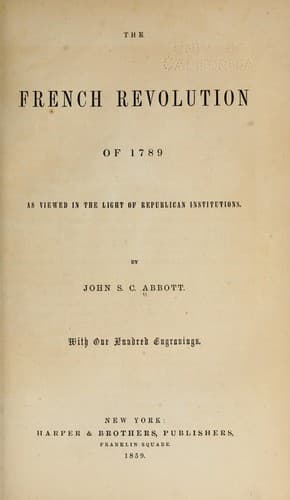
The French Revolution of 1789, as Viewed in the Light of Republican InstitutionsAbbott, John S. C. (John Stevens Cabot)
History
The French Revolution of 1789, as Viewed in the Light of Republican Institutions
Abbott, John S. C. (John Stevens Cabot)
France -- History -- Revolution, 1789-1799
At nine o'clock the Constituent Assembly met, calm, yet fully conscious
of the momentous state of affairs. The president immediately informed
them that M. Bailly, the Mayor of Paris, had come to acquaint them that
the king and royal family had been _carried off_, during the night, by
some enemies of the nation. These noble men conducted, in this crisis,
with their accustomed moderation and dignity. Hesitating to assume that
the king had perjured himself by violating the oath he had so solemnly
taken to sustain the Constitution, they adopted the more generous idea
of his abduction.
La Fayette, at eight o'clock, had been informed of the escape, and
immediately hastened to the Tuileries, where he found M. Bailly, the
Mayor of Paris, and M. Beauharnais, President of the National Assembly.
They were both oppressed in view of the momentous posture of affairs,
and were lamenting the hours which must elapse before the Assembly
could be convoked and a decree issued authorizing pursuit. The course
pursued by La Fayette upon this occasion was worthy of his heroic and
noble nature. He proved himself a consistent disciple of his great
friend and model, Washington.
"Is it your opinion," inquired La Fayette, "that the arrest of the king
and royal family is absolutely essential to the public safety, and can
alone preserve us from civil war?"
"No doubt can be entertained upon that subject," both replied.
"Well, then," returned La Fayette, "I take upon myself all the
responsibility of this arrest."
He immediately issued an order to the National Guard throughout France
for the arrest of the king.[277] It was placed in the hands of two of
his officers, who set out instantly on the pursuit.
Leaving the Tuileries, La Fayette hastened on horseback to the Hôtel de
Ville. He passed excited crowds, who inveighed bitterly against him,
accusing him of traitorous complicity in the king's flight. Arriving at
the Place de Grève, in front of the Hôtel de Ville, he found one of his
officers, the Duke d'Aumont, in the hands of the infuriate mob, who
were on the point of massacring him.
La Fayette instantly plunged into the crowd, by his authoritative voice
and gesture overawed them, and at the imminent peril of his own life
rescued his friend. A moment's hesitation, an emotion of cowardice, and
both would inevitably have perished. An infuriate man, almost delirious
with rage, approached La Fayette, and, shaking his fist in his face,
exclaimed,
"You are a traitor. You have permitted the king to escape, and now
France is ruined."
"How ruined?" La Fayette replied, serenely smiling. "France has
twenty-five millions of inhabitants; the salary of the king is
twenty-five millions of francs. Every one of us gains twenty sous by
Louis XVI. relieving us of this payment."
Public-domain text, read in full here on John Shaqi.
Reviews
Reviews
No reviews yet
Be the first to share your thoughts on this work.
Elsewhere in the archive
Join the Discussion
Join the discussion
Sign in to leave a comment or review.
Sign InorCreate an account