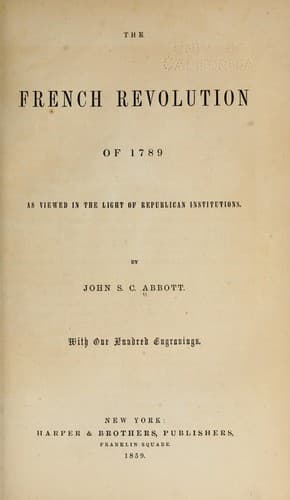
The French Revolution of 1789, as Viewed in the Light of Republican InstitutionsAbbott, John S. C. (John Stevens Cabot)
History
The French Revolution of 1789, as Viewed in the Light of Republican Institutions
Abbott, John S. C. (John Stevens Cabot)
France -- History -- Revolution, 1789-1799
"But why," rejoined Desmoulins, "does the Assembly affect to speak of
the _carrying off_ (enlévement) of the king in its decrees, when the
king himself writes that he escaped of his own free will? What baseness
or what treason in the Assembly to use such language, when we are
threatened by three millions of bayonets!"
"The word _carrying off_," La Fayette replied, "is a mistake in
dictation, which the Assembly will correct. This conduct of the king is
infamous."
The news of the flight of the king created consternation through all
the departments of France. It was regarded as the signal for both
foreign and civil war, and all expected immediately to hear the tramp
of hostile legions. With singular unanimity the people of France
rallied to meet the crisis. From the Gironde a message was sent to the
Assembly, saying,
"We have eighty thousand men enrolled in the National Guard, who are
all ready to march. But we have not as many guns as we have intrepid
and patriotic men. Send us arms."
The municipality of Villepaux sent word, "We are all ready to be torn
into ribbons rather than allow the integrity of the Constitution to be
violated."
"Our fields," wrote the citizens of Allier and Nivernais, "are covered
with harvests and men. Men and harvests are alike at the service of the
country, if she needs them."
"We are but few, but we are determined," wrote the inhabitants of
a little town in Normandy. "We have but two hundred men capable of
bearing arms, but they are young, strong, and courageous. They are all
ready to rush upon any foe who shall invade the soil of France."
Bordeaux assured the Assembly that it would immediately send two
thousand four hundred men to meet the foe. The whole kingdom was in
this blaze of patriotic enthusiasm. The ladies, ever participating
in devotion to a noble cause, sent in their jewelry to the Assembly,
saying,
"Change these ornaments into arms. It is not in our power to combat for
our country; but we can at least aid in arming our brave defenders."
Merchants left their shops, artisans their benches, and laborers the
fields, to toil as volunteers in throwing up fortifications around the
exposed towns. All hearts seemed to vibrate with the same hopes and
fears, and all hands united in the same patriotic toils. The partisans
of the court, few in numbers, were silent, waiting for the approach of
foreign armies before they should throw off the mask and avow their
treason.
FOOTNOTES:
[Footnote 275: Mirabeau, after his interview with Marie Antoinette,
remarked in confidence to a friend, "You know the queen. Her force of
mind is prodigious. She is a man for courage."--_Dumont_, p. 211.]
Public-domain text, read in full here on John Shaqi.
Reviews
Reviews
No reviews yet
Be the first to share your thoughts on this work.
Elsewhere in the archive
Join the Discussion
Join the discussion
Sign in to leave a comment or review.
Sign InorCreate an account