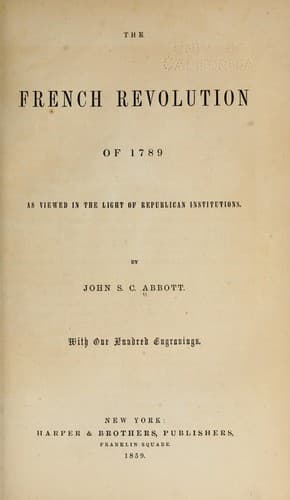
The French Revolution of 1789, as Viewed in the Light of Republican InstitutionsAbbott, John S. C. (John Stevens Cabot)
History
The French Revolution of 1789, as Viewed in the Light of Republican Institutions
Abbott, John S. C. (John Stevens Cabot)
France -- History -- Revolution, 1789-1799
Let us now return to Varennes, and accompany the royal family on their
melancholy route to Paris. We left the royal carriages, under the
escort of the National Guard, just starting from Varennes on their
return. It was eight o'clock in the morning. The progress toward
Chalons was slow, for the carriages could only keep pace with the
guards. The heat was intense, and clouds of dust almost suffocated
the captives. For a time emotions were too deep for utterance, and
not a word was spoken. But often torrents of abuse fell upon the ears
of the king from the crowds who seemed to line the way. At times the
crowd was so dense that with some difficulty the guards forced their
way through. But for the protection of their bayonets, the whole royal
family would probably have fallen victims to the popular fury.
The commissioners from the Assembly met the carriages between Dormans
and Epernay, and immediately assumed the command of the troops, and
took the royal family under their charge. The whole populace, excited
as it was, respected the orders of the Assembly. Latour Maubourg, a
gentleman of noble character and an intimate friend of La Fayette, was
ardently attached to the Constitution, while at the same time he was
anxious to save the monarchy. The tendencies of both of his colleagues
were to a more radical democracy. Hoping to excite their sympathy in
behalf of fallen greatness, he yielded to his companions the honor of
being with the royal family in their carriage, while he took the second
coach, with Madame de Tourzel and some other ladies of the party.
Barnave and Pétion entered the king's carriage to share his danger and
to shield him from insult. Barnave sat on the back seat, between the
king and the queen. Pétion sat in front, between Maria Theresa, the
daughter of the king, and Madame Elizabeth, his sister. The little
dauphin, seven years of age, sat on the lap now of one, then of another.
Barnave was a young lawyer of distinguished abilities and generous
impulses. He was a man of polished manners, of attractive person, and
of accomplished education. His generous heart was saddened by the
pitiable condition of his captives. He did every thing he could, by
kindness and respectful attentions, to mitigate their woe. An obnoxious
priest at one time approached the carriage with an ostentatious
demonstration of his attachment to the court party, now threatening
France with invasion. The exasperated people fell upon him, and he
would probably have been massacred but for the energetic interposition
of Barnave.
"Frenchmen!" he exclaimed, "will you, a nation of brave men, become a
nation of murderers?"
Public-domain text, read in full here on John Shaqi.
Reviews
Reviews
No reviews yet
Be the first to share your thoughts on this work.
Elsewhere in the archive
Join the Discussion
Join the discussion
Sign in to leave a comment or review.
Sign InorCreate an account