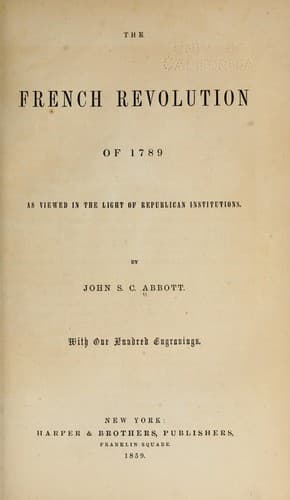
The French Revolution of 1789, as Viewed in the Light of Republican InstitutionsAbbott, John S. C. (John Stevens Cabot)
History
The French Revolution of 1789, as Viewed in the Light of Republican Institutions
Abbott, John S. C. (John Stevens Cabot)
France -- History -- Revolution, 1789-1799
La Fayette, with mistaken humanity, ordered the advance guard to fire
into the air. The harmless volley was followed by shouts of derision
and defiance. It now became necessary to give the fatal order. One
volley swept the field. The crash was followed by a shriek, as four
hundred dead or wounded fell upon the plain, and as the smoke passed
away the whole tumultuous mass was seen flying in terror over the
embankments and through the avenues. The artillerymen, with the
coolness of trained soldiers, were just upon the point of opening their
fire of grapeshot upon the panic-stricken fugitives, when La Fayette,
unable to make his voice heard through the uproar, heroically threw
himself before the cannon, and thus saved the lives of thousands. The
National Guard, saddened by the performance of a duty as painful as
it was imperious, returned in the evening through the dark streets of
Paris and dispersed to their homes.[296]
The next day M. Bailly appeared before the Assembly, and, in terms of
dignity and manly sorrow, reported the triumph of the law. Both the
National Assembly and the municipality of Paris voted their cordial
approval of the conduct of Bailly and La Fayette. The Jacobin press,
however, gave utterance to the fiercest invectives. Bailly and La
Fayette were denounced as murderers, and every effort was made to
exasperate the passions of the populace.
Amid such scenes of agitation and violence the Assembly concluded
its task of forming a constitution. The important document, which
was but partially finished at the great celebration on the 14th of
July, 1790, was now completed. None were, however, fully satisfied
with the Constitution. The aristocratic party abhorred the democratic
spirit with which it was pervaded, and yet wished to make it still
more obnoxiously democratic, that monarchical Europe might be more
thoroughly exasperated. The Jacobins held it up to derision and
execration because it was not democratic enough. The moderate party,
represented by such men as La Fayette and Barnave, wished to invest
the king with more power, but dared not attempt any revision of the
Constitution, with the aristocrats and the Jacobins both ready to
combine against them.
Napoleon was at this time a young officer in the army, twenty-three
years of age. His brother Joseph was studying law in Italy. The whole
family had warmly espoused the popular cause. From the beginning
Napoleon was the ardent advocate of equal rights, and the determined
foe of mob violence. At this early period of the Revolution, he
expressed the views to which he adhered through the whole of his career.
Public-domain text, read in full here on John Shaqi.
Reviews
Reviews
No reviews yet
Be the first to share your thoughts on this work.
Elsewhere in the archive
Join the Discussion
Join the discussion
Sign in to leave a comment or review.
Sign InorCreate an account