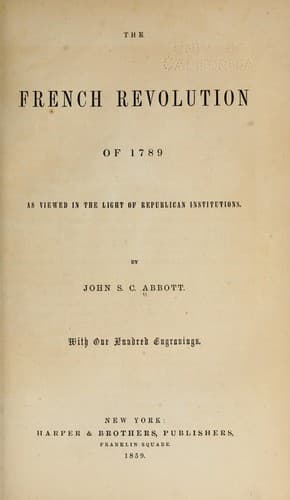
The French Revolution of 1789, as Viewed in the Light of Republican InstitutionsAbbott, John S. C. (John Stevens Cabot)
History
The French Revolution of 1789, as Viewed in the Light of Republican Institutions
Abbott, John S. C. (John Stevens Cabot)
France -- History -- Revolution, 1789-1799
The whole future career of Napoleon was in consistency with the spirit
of these remarks. "I frankly declare," said Napoleon, subsequently,
"that if I were compelled to choose between the old monarchy and
Jacobin misrule, I should infinitely prefer the former."
On the 3d of September the Constitution was presented to the king for
his acceptance with imposing ceremonies.[298] At nine o'clock in the
evening a deputation left the chamber of the Assembly, and, escorted
by a numerous and brilliant guard of honor, entered the Chateau of
the Tuileries. The multitudes who thronged the way applauded loudly.
The king, surrounded by his ministers and other high officers of the
kingdom, received the deputation in his council-chamber. M. Thouret,
president of the commission, presented the Constitution to the king,
saying,
"Sire! the representatives of the nation come to present to your
majesty the constitutional act which consecrates the indefeasible
rights of the French people, which gives to the throne its true
dignity, and regenerates the government of the empire."
The king, with a countenance expressive of satisfaction, received the
document, and replied that he would examine it, and, after the shortest
possible delay, communicate his decision to the Assembly. On the 13th
he sent a message to the Assembly, which Barnave had assisted him in
drawing up, and which contained the following conciliatory and noble
sentiments:
"I have examined the Constitution. I accept it and will carry it into
execution. The will of the people is no longer doubtful to me, and
therefore I accept the Constitution. I freely renounce the co-operation
I had claimed in this work, and I declare that when I have renounced
it no other but myself has any right to claim it. Let the absent who
are restrained by the fear of persecutions return to their country
in safety. Let us consent to a mutual forgiveness of the past and
obliterate all accusations arising from the events of the Revolution
in a general reconciliation. I do not refer to those which have been
caused by an attachment to me. Can you see any guilt in them? I will
present myself to-morrow at noon to the National Assembly, and take
oath to the Constitution in the very place where it has been drawn up."
This frank and cordial assent was unanticipated. It created a burst of
extraordinary joy. La Fayette, in response to the suggestion of the
king, immediately proposed a general amnesty for all acts connected
with the Revolution. The motion was carried by acclaim. For a moment
all parties seemed again to be united, prisons were thrown open,
captives liberated, and shouts of fraternity and happiness resounded
through Paris.
The next day the king went to the Assembly and took his seat by the
side of the president. He was received by all the members standing, and
they remained standing while he addressed them. With the most earnest
expression of sincerity and satisfaction, the king said,
Public-domain text, read in full here on John Shaqi.
Reviews
Reviews
No reviews yet
Be the first to share your thoughts on this work.
Elsewhere in the archive
Join the Discussion
Join the discussion
Sign in to leave a comment or review.
Sign InorCreate an account