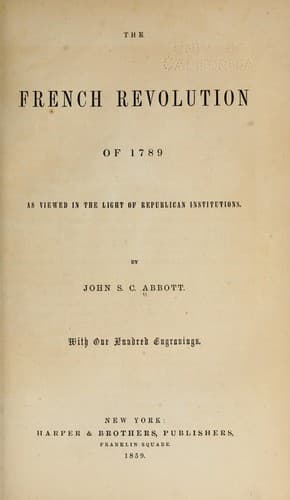
The French Revolution of 1789, as Viewed in the Light of Republican InstitutionsAbbott, John S. C. (John Stevens Cabot)
History
The French Revolution of 1789, as Viewed in the Light of Republican Institutions
Abbott, John S. C. (John Stevens Cabot)
France -- History -- Revolution, 1789-1799
"Gentlemen, after the completion of the Constitution, you have resolved
on to-day for the termination of your labors. I will exercise all the
power confided to me in assuring to the Constitution the respect and
obedience which is its due. For you, gentlemen, who, during a long and
painful career, have evinced an indefatigable zeal in your labors,
there remains a last duty to fulfill, when you are scattered over the
face of the empire. It is to enlighten your fellow-citizens as to the
spirit of the laws you have made; to purify and unite opinions by the
example you will give to the love of order and submission to the laws.
Be, on your return to your homes, the interpreters of my sentiments
to your fellow-citizens. Tell them that the king will always be their
first and most faithful friend; that he desires to be loved by them,
and can only be happy with them and by them."
The king left the hall amid the loudest acclamations. They were
the last with which he was greeted. Thouret, the president of the
Assembly, as soon as the king had retired, said in a loud voice, "The
Constituent Assembly pronounces its mission accomplished, and that its
sittings now terminate." Thus closed the truly patriotic Assembly. It
had accomplished the greatest and the most glorious revolution ever
achieved in so short a time, and with so little violence. Repressing
alike the despotism of aristocracy and the lawlessness of the mob, it
established a constitution containing the essential elements of liberty
protected by law. Under this constitution France might have advanced
in prosperity. But the aristocrat and the Jacobin combined in its
overthrow. They were fatally successful in their efforts.
It is interesting to observe how differently the same events were
regarded by different minds. Bertrand de Moleville, a warm partisan of
the aristocracy, says,
"Thus terminated this guilty Assembly, whose vanity, ambition,
cupidity, ingratitude, ignorance, and audacity have overturned the most
ancient and the noblest monarchy of Europe, and rendered France the
theatre of every crime, of every calamity, and of the most horrible
catastrophe. Can these treacherous representatives ever justify
themselves in the eyes of the nation for having so unworthily abused
their confidence and their powers?"
On the other hand, the democratic historians, the "Two Friends
of Liberty," while regretting that the Constitution was not more
thoroughly democratic, say,
Public-domain text, read in full here on John Shaqi.
Reviews
Reviews
No reviews yet
Be the first to share your thoughts on this work.
Elsewhere in the archive
Join the Discussion
Join the discussion
Sign in to leave a comment or review.
Sign InorCreate an account