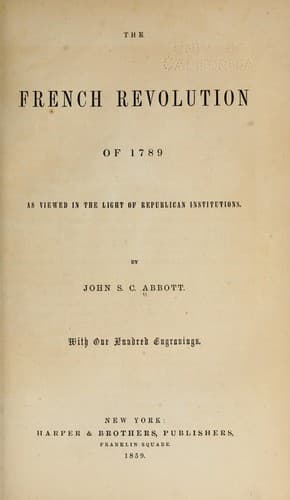
The French Revolution of 1789, as Viewed in the Light of Republican InstitutionsAbbott, John S. C. (John Stevens Cabot)
History
The French Revolution of 1789, as Viewed in the Light of Republican Institutions
Abbott, John S. C. (John Stevens Cabot)
France -- History -- Revolution, 1789-1799
Under this state of affairs, the French embassador, in January, 1792,
was instructed to inform the Austrian government that there was reason
to apprehend that a coalition was being formed against the sovereignty
and independence of France, and to inquire of Leopold whether he
did or did not intend to interfere against the French Revolution.
Thus pressed, the Austrian cabinet returned an answer containing the
following avowal:
"When France gave to Europe the spectacle of a lawful king forced by
atrocious violence to fly, protesting solemnly against the acquiescence
which they had extorted from him, and a little afterward stopped and
detained prisoner by his subjects--yes, it then _did_ concern the
brother-in-law and the ally of the king to invite the other powers
of Europe to join with him in a declaration to France that they all
view the cause of his most Christian majesty as their own; that they
demand that this prince and his family be set at liberty and have power
to go where they please; and they require for these royal personages
inviolability and due respect, which by the law of nature and nations
are due from subjects to their princes; that they will unite to avenge
in the most signal manner every farther attempt that may be committed,
or may be suffered to be committed, against the liberty, the honor, and
the safety of the king, the queen, and the royal family; and that,
finally, they will not acknowledge as constitutional and legally
established in France any laws but those which shall have the voluntary
acquiescence of the king, enjoying perfect liberty. But if, on the
other hand, these demands are not complied with, they will in concert
employ all the means in their reach to put a stop to the scandalous
usurpation of power which bears the appearance of an open rebellion,
and which, from the dangers of the example, it concerns all the
governments of Europe to repress."
The Republican party in the Legislative Assembly were called the
Girondists because their leaders were generally from the department
of the Gironde. The evidence to them was conclusive, and is now
universally admitted, that the king, instead of sustaining the
Constitution, was conspiring with the emigrants and the foreign powers
for its overthrow. The Girondists, thus assured that the king was
hostile to constitutional liberty while pretending that he was its
friend that he might more effectually assail it, were anxious for his
dethronement and for the establishment of a republic. Candor surely
can not censure them. Twenty-five millions of men were not bound to
place their liberties in the hands of a monarch who was conspiring with
foreign foes to enslave them anew.
Public-domain text, read in full here on John Shaqi.
Reviews
Reviews
No reviews yet
Be the first to share your thoughts on this work.
Elsewhere in the archive
Join the Discussion
Join the discussion
Sign in to leave a comment or review.
Sign InorCreate an account