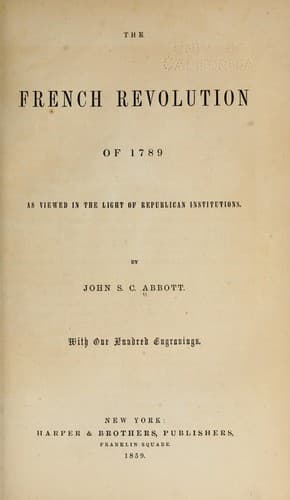
The French Revolution of 1789, as Viewed in the Light of Republican InstitutionsAbbott, John S. C. (John Stevens Cabot)
History
The French Revolution of 1789, as Viewed in the Light of Republican Institutions
Abbott, John S. C. (John Stevens Cabot)
France -- History -- Revolution, 1789-1799
"You see me," she said, "very sad. I dare not approach the window which
looks into the garden. Yesterday evening I went to the window toward
the court just to take a little air. A gunner of the guard addressed me
in terms of vulgar abuse, adding, 'How I should like to see your head
on the point of my bayonet!' In this horrid garden you see on one side
a man, mounted on a chair, reading aloud the most abominable calumnies
against us; on the other, a military man or an abbé dragged through
one of the basins, overwhelmed with abuse, and beaten, while others
are playing at ball, or quietly walking about. What an abode! what a
people!"
The Austrian monarchy, supported by the other powers of Europe, now
sent to France the insolent demand that the French monarchy should
be restored almost to its pristine despotic power; that the three
estates of the realm--the clergy, the nobles, and the _tiers état_,
should be re-established, and that there should be the restitution of
Church property. It is not surprising that an independent nation of
twenty-five millions should have resented such impertinence. There was
a general cry of indignation from the Assembly, which was re-echoed
by the people, and new vigor was infused on both sides into the
preparations for the war.
The king was sorely perplexed. In the event of war, victory would but
strengthen the Revolutionary party; defeat would expose him to the
charge of treason in feebly conducting hostilities. But France would
not yield to this insulting foreign dictation, and the pressure of
public opinion fell so strong upon the king that he was constrained,
much against his will, to issue a declaration of war. Pale and
care-worn the king entered the Assembly, and, after presenting through
his minister a report of the demands of Austria, with a faltering voice
read his speech.
"Gentlemen," said he, "you have heard the result of the negotiation in
which I have been engaged with the court of Vienna. The conclusions of
the report have been unanimously adopted by my council. I have myself
adopted them. All would rather have war than see the dignity of the
French people any longer insulted and the national security threatened.
Having employed all possible means to obtain peace, I come now,
agreeably to the terms of the Constitution, to propose to the National
Assembly war against the King of Hungary and Bohemia."[320]
The proposal was received with shouts of "_Vive le Roi_," and the
decree was passed by a great majority.[321] In the debates which the
question of war had excited, great eloquence was displayed in the
Assembly. M. Isnard spoke in terms of enthusiasm which brought the
whole Assembly to their feet.
[Illustration: LOUIS XVI. IN THE NATIONAL ASSEMBLY.]
Public-domain text, read in full here on John Shaqi.
Reviews
Reviews
No reviews yet
Be the first to share your thoughts on this work.
Elsewhere in the archive
Join the Discussion
Join the discussion
Sign in to leave a comment or review.
Sign InorCreate an account