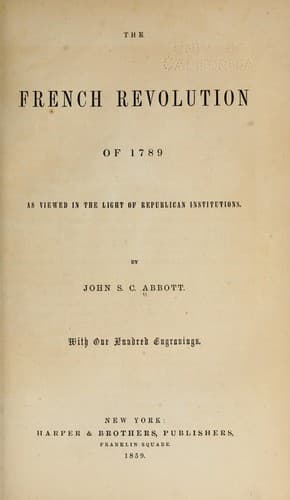
The French Revolution of 1789, as Viewed in the Light of Republican InstitutionsAbbott, John S. C. (John Stevens Cabot)
History
The French Revolution of 1789, as Viewed in the Light of Republican Institutions
Abbott, John S. C. (John Stevens Cabot)
France -- History -- Revolution, 1789-1799
The most vigorous preparations were now made on both sides for the
prosecution of the war. Francis of Austria and Frederick of Prussia
met the Duke of Brunswick, Generallissimo of the Confederation, at
Frankfort. The duke, who had married a sister of George III. of
England, was an energetic, veteran soldier, fifty years of age. His
head-quarters were at Coblentz, a town at the confluence of the Moselle
and the Rhine, in the state of the Elector of Treves. Twenty-two
thousand French emigrants had assembled there in arms. Seven French
princes of the House of Bourbon were marshaling them for battle against
their native land--to crush the people struggling for liberty--to rivet
anew the fetters of the most execrable despotism. These princes were
the two brothers of the king, Louis and Charles, the one subsequently
Louis XVIII., the other Charles X.; the Duke of Berri and the Duke of
Angoulême, sons of Charles; the Prince of Condé, cousin of the king,
his son, the Duke of Bourbon, and his grandson, the Duke d'Enghien.
All the military noblesse of the kingdom, with the exception of the few
who had accepted the Constitution, had deserted their garrisons and
united in the most atrocious act of treason. They were not only ready
to march themselves, but were combining despotic Europe to march with
them to crush the liberties of their country.
The peril of the king was now hourly increasing, for he was playing
a double part. While publicly declaring war he was secretly carrying
on a correspondence with the emigrants and with the foreign powers,
encouraging them to make war upon France. This was known by some, and
suspicions of the king's sincerity were spreading rapidly among the
people. He had many papers in his possession, which, if discovered,
would cause his ruin. To conceal them he had an iron chest built
into the thick wall of one of his apartments. This was done by the
confidential locksmith who had been his companion at the forge for ten
years. The wall was painted to resemble large stones. The openings of
the panel were masked in the brown grooves. But after constructing this
safe the king was apprehensive that his locksmith would betray him,
and he consequently intrusted a portfolio containing many of his most
important papers to the care of Madame Campan.
Public-domain text, read in full here on John Shaqi.
Reviews
Reviews
No reviews yet
Be the first to share your thoughts on this work.
Elsewhere in the archive
Join the Discussion
Join the discussion
Sign in to leave a comment or review.
Sign InorCreate an account