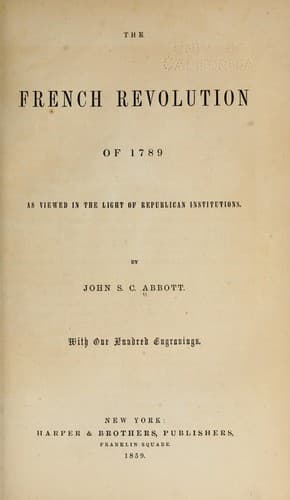
The French Revolution of 1789, as Viewed in the Light of Republican InstitutionsAbbott, John S. C. (John Stevens Cabot)
History
The French Revolution of 1789, as Viewed in the Light of Republican Institutions
Abbott, John S. C. (John Stevens Cabot)
France -- History -- Revolution, 1789-1799
"The question then is, Was this (the conduct of Austria) an
interference in the internal affairs of France that justified a
declaration of war on the part of France or not? This is a point on
which, under the extraordinary circumstances of the case, reasoners
may differ, but I conceive that it was. The rulers of France, at the
time, saw themselves menaced, stigmatized, and, as nearly as possible,
proscribed by a foreign power on account of their conduct to their
own king, in their own country. They could expect nothing but exile,
imprisonment, and death if these foreign powers invaded their country
in defense of the monarchy and succeeded; and not only this, but, in
that case, a counter-revolution was inevitable.
"I must confess that, with all my horror of war, of counsels of
violence, of enthusiastic and furious men like these Girondists, and
of dreadful and guilty men like these Jacobins, I must confess that
upon this particular point of the Austrian war I am, on the whole,
compelled to agree with them. I see not how, upon any other principle,
the peace of the world can be maintained, or the proper sovereignty
and independence of nations be preserved, nor, finally, upon any other
principle, what chance there can ever be for the general cause of the
freedom of mankind."]
[Footnote 323: Dumas, vol. i., p. 213.]
[Footnote 324: Memoirs of Dumouriez.]
[Footnote 325: "The most menacing cries were uttered aloud, even in the
Tuileries. They called for the destruction of the throne and the murder
of the sovereign. These insults assumed the character of the very
lowest of the mob. The queen, one day, hearing roars of laughter under
her windows, desired me to see what it was about. I saw a man, almost
undressed, turning his back toward her apartments. My astonishment and
indignation were apparent. The queen rose to come forward. I held her
back, telling her it was a very gross insult offered by one of the
rabble."--_Memoirs of Marie Antoinette, by Madame Campan_, vol. ii., p.
205.]
[Footnote 326: Madame Campan, vol. ii., p. 206.]
[Footnote 327: Montjoie, one of the most decided of Royalist writers,
thus describes Santerre: "The muscular expansion of his tall person,
the sonorous hoarseness of his voice, his rough manners, and his easy
and vulgar eloquence, of course made him a hero among the lower rabble.
And, in truth, he had gained a despotic empire over the dregs of the
faubourgs. He moved them at will, but that was all he knew how to do,
or could do, for, as to the rest, he was neither wicked nor cruel. He
engaged blindly in all conspiracies, but he never was guilty of the
execution of them, either by himself or by those who obeyed him. He
was always concerned for an unfortunate person, of whatever party he
might be. Affliction and tears disarmed his hands."--_History of Marie
Antoinette, by Montjoie_, p. 295.]
Public-domain text, read in full here on John Shaqi.
Reviews
Reviews
No reviews yet
Be the first to share your thoughts on this work.
Elsewhere in the archive
Join the Discussion
Join the discussion
Sign in to leave a comment or review.
Sign InorCreate an account