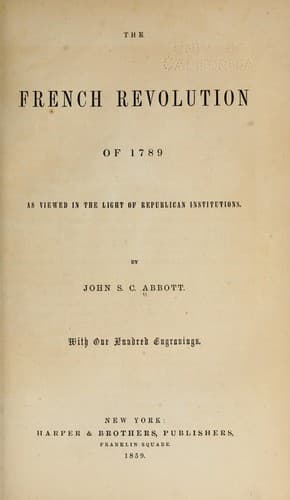
The French Revolution of 1789, as Viewed in the Light of Republican InstitutionsAbbott, John S. C. (John Stevens Cabot)
History
The French Revolution of 1789, as Viewed in the Light of Republican Institutions
Abbott, John S. C. (John Stevens Cabot)
France -- History -- Revolution, 1789-1799
Though it was well known to all intelligent men that the Prussian
armies were marching to unite with the Austrian for the invasion of
France, yet the king, in grossest violation of duty, had made no
communication of the fact to the Legislative Assembly. All the great
roads were crowded with priests, nobles, and their partisans, hastening
to join the emigrants at Coblentz. Couriers were every where traversing
Europe, from St. Petersburg to Rome, from Stockholm to Madrid, from
Berlin to Naples, openly announcing the coalition of all Europe to
crush the revolution in France, and declaring that the armies would
move in such force that the French would not be able to resist them
for a single month. The allies were not unwilling to have their plans
known and even exaggerated, for some of them hoped that the terror
of the threat might be sufficient to drive the French patriots to
submission.[334]
It was consequently proclaimed, not officially, but with great
soundings of trumpets, that Spain was to indemnify herself for the
war by taking possession of the four beautiful southern provinces
of France which lean against the Pyrenees--Navarre, Roussillon,
Languedoc, and Guienne. The King of Sardinia was to receive the
provinces adjacent to his kingdom, whose romantic valleys penetrated
the lower Alps--Dauphiny, Provence, Lyonnois, and Bretagne. The
Stadtholder of Holland was to extend his sway over the Provinces of
Flanders and Picardy. Austria was to grasp the provinces adjoining the
Rhine--Alsace, Lorraine, Champagne. The Swiss were offered Franche
Comte if they would join the coalition. And, finally, England was
to regain her old possession of Normandy, and was to seize all the
colonial possessions of France in the two Indies.[335]
Though the British _government_ was at this time strongly in sympathy
with the coalition, it did not venture openly to join the alliance,
for the masses of the British _people_ were cordially with the French
patriots and rejoiced in the establishment of constitutional liberty in
France. These extravagant threats filled Europe. It was every where
assumed that only a small minority of the French people were opposed to
the Old Régime, and that the mass of the nation would at once arise and
welcome the invading armies.
Public-domain text, read in full here on John Shaqi.
Reviews
Reviews
No reviews yet
Be the first to share your thoughts on this work.
Elsewhere in the archive
Join the Discussion
Join the discussion
Sign in to leave a comment or review.
Sign InorCreate an account