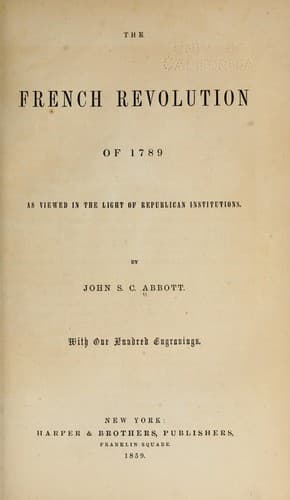
The French Revolution of 1789, as Viewed in the Light of Republican InstitutionsAbbott, John S. C. (John Stevens Cabot)
History
The French Revolution of 1789, as Viewed in the Light of Republican Institutions
Abbott, John S. C. (John Stevens Cabot)
France -- History -- Revolution, 1789-1799
The iron-hearted minister was unrelenting, and died leaving his victim
still in the dungeon. There Dessault remained _fifty years_ after
the death of Richelieu. He was at length liberated, after having
passed sixty-one years in a loathsome cell but a few feet square. The
mind stands aghast in the contemplation of such woes. All this he
suffered as the punishment of his _virtues_. The mind is appalled in
contemplating such a doom. Even the assurance that after death cometh
the judgment affords but little relief. Michelet, an unbeliever in
Christian revelation, indignantly exclaims, "though a sworn enemy to
barbarous fictions about everlasting punishment, I found myself praying
to God to construct a hell for tyrants."
When we remember that during a single reign one hundred and fifty
thousand were thus incarcerated; that all the petted and profligate
favorites of the king, male and female, had these blank warrants
placed in their hands, which they could fill up with any name at their
pleasure; that money could be thus extorted, domestic virtue violated,
and that every man and every family was thus placed at the mercy of
the vilest minions of the court, we can only wonder that the volcano
of popular indignation did not burst forth more speedily and more
desolatingly. It is true that in many other countries of Europe the
state of affairs was equally bad, if not worse. But in France wealth
and intelligence had made great advances, while in central and northern
Europe the enslaved people were so debased by ignorance that they had
no consciousness of the rights of which they were defrauded.
The court demanded of a rich man, M. Massat, six hundred thousand
livres ($120,000). Stunned by the ruinous demand, he ventured to
remonstrate. He was dragged to the Bastille, where the vermin of his
dungeon could alone hear his murmurs. M. Catalan, another man of
wealth, after experiencing the horrors of such an imprisonment for
several months, was glad to purchase his ransom for six millions of
livres ($1,200,000).[37]
The money thus extorted was squandered in the most shameless
profligacy. The king sometimes expended two hundred thousand dollars
for a single night's entertainment at Versailles. The terrors of the
Bastille frowned down all remonstrances. A "stone doublet" was the
robe which the courtiers facetiously remarked they had prepared for
murmurers.
Public-domain text, read in full here on John Shaqi.
Reviews
Reviews
No reviews yet
Be the first to share your thoughts on this work.
Join the Discussion
Join the discussion
Sign in to leave a comment or review.
Sign InorCreate an account