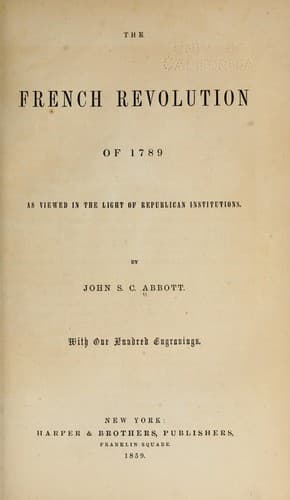
The French Revolution of 1789, as Viewed in the Light of Republican InstitutionsAbbott, John S. C. (John Stevens Cabot)
History
The French Revolution of 1789, as Viewed in the Light of Republican Institutions
Abbott, John S. C. (John Stevens Cabot)
France -- History -- Revolution, 1789-1799
On the 1st of May, 1749, a gentleman of the name of Latude was arrested
by one of these _lettres de cachet_, and thrown into the Bastille. He
was then but twenty years of age, and had given offense to Madame de
Pompadour, by pretending that a conspiracy had been formed against
her life. For thirty-five years he remained in prison enduring
inconceivable horrors. In 1784, several years after the death of both
the mistress and her subject king, he was liberated and wrote an
account of his captivity. It was a tale of horror which thrilled the
ear of Europe. Eloquently, in view of the letters of Latude, Michelet
represents the people as exclaiming,
"Holy, holy Revolution, how slowly dost thou come! I, who have been
waiting for thee a thousand years in the furrows of the Middle Ages,
what! must I wait still longer? Oh, how slowly time passes! Oh, how
have I counted the hours! Wilt thou never arrive?"
A young man, in a Jesuit College, in a thoughtless hour, composed
a satirical Latin distich, making merry with the foibles of the
professors and of the king. A _lettre de cachet_ was immediately served
upon him, and for _thirty-one years_, until youth and manhood were
giving place to old age, he remained moaning in living burial in one of
the dungeons of the Bastille. One of the first acts of the Revolution
was to batter down these execrable walls and to plow up their very
foundations.
In view of the facts here revealed one can not but be amazed at the
manner in which many have spoken of the French Revolution, as if it
were merely an outburst of human depravity. "Burke had no idea," writes
De Tocqueville, "of the state in which the monarchy, he so deeply
regretted, had left us." Michelet, glowing with the indignation which
inflamed the bosoms of his fathers, exclaims, "Our fathers shivered
that Bastille to pieces, tore away its stones with bleeding hands,
and flung them afar. Afterward they seized them again, and, having
hewn them into a different form, in order that they might be trampled
under foot by the people forever, built with them the Bridge of
Revolution."[38]
FOOTNOTES:
[Footnote 35: Historical View of French Revolution, by J. Michelet, i.,
66.]
[Footnote 36: History of the Bastille, Chambers' Miscellany.]
[Footnote 37: Old Régime, p. 191.]
CHAPTER VI.
THE COURT AND THE PARLIAMENT.
Death of Louis XV.--Education of Louis XVI.--Maurepas,
Prime Minister.--Turgot; his Expulsion from
Office.--Necker.--Franklin.--Sympathy with the Americans.--La
Fayette.--Views of the Court.--Treaty with America.--Popularity
of Voltaire.--Embarrassment of Necker.--_Compte Rendu au
Roi._--Necker driven into Exile.--Enslavement of France.--New
Extravagance.--Calonne.
Public-domain text, read in full here on John Shaqi.
Reviews
Reviews
No reviews yet
Be the first to share your thoughts on this work.
Join the Discussion
Join the discussion
Sign in to leave a comment or review.
Sign InorCreate an account