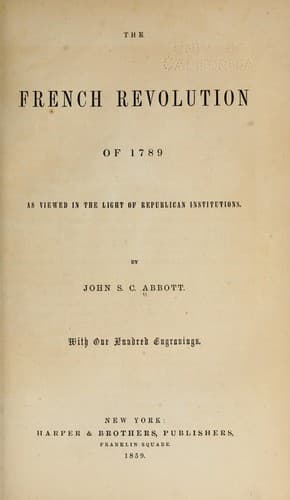
The French Revolution of 1789, as Viewed in the Light of Republican InstitutionsAbbott, John S. C. (John Stevens Cabot)
History
The French Revolution of 1789, as Viewed in the Light of Republican Institutions
Abbott, John S. C. (John Stevens Cabot)
France -- History -- Revolution, 1789-1799
M. Turgot was appointed to the post of utmost difficulty and
danger--the administration of the finances. He had acquired much
reputation by the skill with which, for twelve years, he had
administered the government of the Province of Limousin. The kingdom of
France was already in debt more than four thousand millions of francs
($800,000,000).[43] As the revenue was by no means sufficient to pay
the interest upon this debt and the expenses of the government, new
loans had been incessantly resorted to, and national bankruptcy was
near at hand. To continue borrowing was ruin; to impose higher taxes
upon the people impossible. There were but two measures which could
be adopted. One was to introduce a reform of wide-sweeping and rigid
economy, cutting down salaries, abolishing pensions and sinecures, and
introducing frugality into the pleasure-haunts of the court. Turgot was
too well acquainted with the habits of the courtiers to dream that it
was in the power of any minister to enforce this reform. There remained
only the plan to induce the clergy and the nobles to allow themselves
to be taxed, and thus to bear their fair proportion of the expenses of
the state. Turgot fully understood the Herculean task before him in
attempting this measure, and in a letter to the king he wrote:
"We will have no bankruptcies, no augmentation of the taxes, no loans.
I shall have to combat abuses of every kind, to combat those who are
benefited by them, and even the kindness, sire, of your own nature. I
shall be feared, hated, and calumniated; but the affecting goodness
with which you pressed my hands in yours, to witness your acceptance
of my devotion to your service, is never to be obliterated from my
recollection, and must support me under every trial."[44]
Several of Turgot's measures of reform the privileged class submitted
to, though with reluctance and with many murmurs; but when he proposed
that a tax should be fairly and equally levied upon proprietors of
every description, a burst of indignant remonstrance arose from the
nobles which drowned his voice. To suggest that a _high-born_ man was
to be taxed like one _low-born_ was an insult too grievous to be borne.
The whole privileged class at once combined, determined to crush the
audacious minister thus introducing the doctrine of equal taxation into
the court of aristocratic privilege.
Public-domain text, read in full here on John Shaqi.
Reviews
Reviews
No reviews yet
Be the first to share your thoughts on this work.
Join the Discussion
Join the discussion
Sign in to leave a comment or review.
Sign InorCreate an account