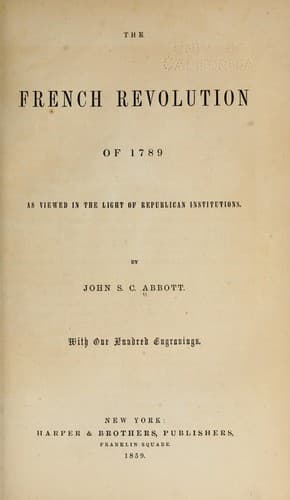
The French Revolution of 1789, as Viewed in the Light of Republican InstitutionsAbbott, John S. C. (John Stevens Cabot)
History
The French Revolution of 1789, as Viewed in the Light of Republican Institutions
Abbott, John S. C. (John Stevens Cabot)
France -- History -- Revolution, 1789-1799
Madame du Barry, in a pet, four years before, had abolished the
Parliament of Paris, which was entirely under the control of the
aristocracy. Louis XVI., seeking popularity, restored the Parliament.
Unfortunately for reform, the nobles had now an organized body with
which to make resistance. The Parliament, the clergy, the old minister
Maurepas, and even the young queen, all united in a clamorous onset
upon Turgot, and he was driven from the ministry, having been in office
but twenty months.[45] The Parliament absolutely refused to register
the obnoxious decree. The inexperienced and timid king, frightened
by the clamor, yielded, and abandoned his minister. Had the king
been firm, he might, perhaps, have carried his point; but want of
capacity leads to results as disastrous as treachery, and the king,
though actuated by the best intentions, was ignorant and inefficient.
Though the king held a _bed of justice_,[46] and ordered the edicts
registered, they remained as dead letters and were never enforced.
There was in Paris a wealthy Protestant banker, born in Geneva, of
great financial celebrity, M. Necker. He was called to take the place
of Turgot. Warned by the fate of his predecessor and seeing precisely
the same difficulties staring him in the face, he resolved to try the
expedient of economy, cutting off pensions and abolishing sinecures.
But the nobles, in Church and State, disliked this as much as being
taxed, and immediately their clamor was renewed.[47]
Just at this time the American war of independence commenced. All
France was in a state of enthusiasm in view of a heroic people
struggling to be free. And when the American delegation appeared in
Paris, headed by Franklin, all hearts were swept along by a current
which neither king nor nobles could withstand. The republican
simplicity of Franklin in his attire and manners produced an
extraordinary impression upon all classes. The French ladies in
particular were lavish in their attentions. Several fêtes were given
in his honor, at one of which the most beautiful of three hundred
ladies crowned him with a laurel wreath, and then kissed him on both
cheeks. Almost every saloon was ornamented with his bust, bearing the
inscription, "Eripuit coelo fulmen, sceptrumque tyrannis."
Public-domain text, read in full here on John Shaqi.
Reviews
Reviews
No reviews yet
Be the first to share your thoughts on this work.
Join the Discussion
Join the discussion
Sign in to leave a comment or review.
Sign InorCreate an account