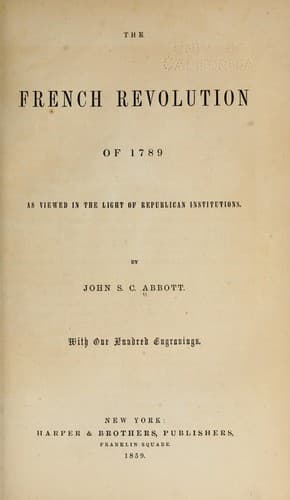
The French Revolution of 1789, as Viewed in the Light of Republican InstitutionsAbbott, John S. C. (John Stevens Cabot)
History
The French Revolution of 1789, as Viewed in the Light of Republican Institutions
Abbott, John S. C. (John Stevens Cabot)
France -- History -- Revolution, 1789-1799
In the midst of these transactions Voltaire, after an absence of
twenty-seven years, much of which time he had passed in his retreat
at Ferney, about five miles from Geneva, revisited Paris. He was
then eighty-four years of age. The court hated the bold assailer of
corruptions, and refused to receive him. But the populace greeted him
with enthusiasm unparalleled. He attended the theatre where his last
play, "Irene," was acted. Immediately upon his appearance the whole
audience, rising, greeted him with long and tumultuous applause. As,
overpowered with emotion, he rose to depart, with trembling limbs and
with flooded eyes, men of the highest rank and beautiful women crowded
around him and literally bore him in their arms to his carriage. He
could only exclaim, "Do you wish to kill me with joy?" A crowd with
lighted torches filled the streets, making his path brilliant as day,
and shouts of triumph arose which appalled the courtiers in the saloons
of the palace. A few weeks after this, May 30, 1778, Voltaire died.
The Archbishop of Paris refused to allow him Christian burial, and the
court forbade his death to be mentioned in the public journals. His
corpse was taken from the city and buried secretly at an old abbey at
Scellières. This petty persecution only exasperated the friends of
reform. A month after the death of Voltaire, Rousseau also passed away
to the spirit-land.
The situation of Necker was now deplorable. The kingdom was involved
in an enormously expensive war. The court would not consent to any
diminution of its indulgences, and the privileged class would not
consent to be taxed. Necker was almost in despair. He borrowed of
every one who would lend, and from the already exhausted people with
sorrow, almost with anguish, gleaned every sou which the most ingenious
taxation could extort.
"Never shall I forget," he wrote, in 1791, "the long, dark staircase of
M. Maurepas, the terror and the melancholy with which I used to ascend
it, uncertain of the success of some idea that had occurred to me,
likely, if carried into effect, to produce an increase of the revenue,
but likely at the same time to fall severely though justly on some one
or other; the sort of hesitation and diffidence with which I ventured
to intermingle in my representations any of those maxims of justice
and of right with which my own heart was animated."
Public-domain text, read in full here on John Shaqi.
Reviews
Reviews
No reviews yet
Be the first to share your thoughts on this work.
Elsewhere in the archive
Join the Discussion
Join the discussion
Sign in to leave a comment or review.
Sign InorCreate an account