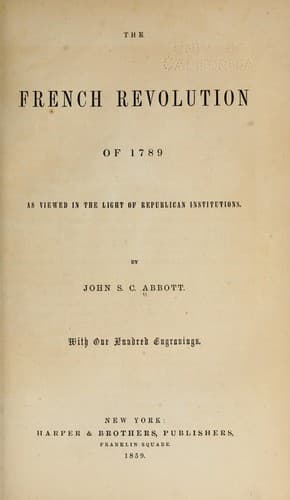
The French Revolution of 1789, as Viewed in the Light of Republican InstitutionsAbbott, John S. C. (John Stevens Cabot)
History
The French Revolution of 1789, as Viewed in the Light of Republican Institutions
Abbott, John S. C. (John Stevens Cabot)
France -- History -- Revolution, 1789-1799
All the latent spirit of freedom which had so long been slowly
accumulating burst forth with a power which alarmed the court. Not a
few of the nobles, disgusted with the aristocratic oppression which
was ruining France, gave their sympathies to the American cause.
The Marquis la Fayette, then but eighteen years of age, openly and
enthusiastically applauded the struggle of the colonists. Marie
Antoinette, instinctively hating a war in which the people were
contending against royalty, expressed much indignation that La Fayette
should utter such sentiments in the Palace of Versailles. Joseph
II. of Austria, brother of Marie Antoinette, then on a visit to the
French court, was asked by a lady his opinion of the subject which
was now engrossing every mind. He replied, "I must decline answering;
my business is to be a Royalist" (_Mon métier à moi c'est d'être
Royaliste_).[48]
It is hardly possible for one now to realize the enthusiasm with
which the American war, at that time, inspired France. Even the court
hated England, and wished to see that domineering power humbled. The
mind of the nation had just awakened and was thoroughly aroused from
the lethargy of ages. Theories, dreams, aspirations had exhausted
themselves, and yet there was in France no scope whatever for action.
America opened a theatre for heroic enterprise. France had given the
theory of liberty, America was illustrating that theory by practice.
The popular cry so effectually drowned every other voice that even the
king was compelled to yield. A treaty with America was signed which
drew from the treasury of France twelve hundred millions of francs
($240,000,000), in support of American independence.[49] But for the
substantial aid thus rendered by the fleet and the army of France it
can hardly be doubted that the American Revolution would have been
crushed, Washington and Franklin would have been hanged as traitors,
and monarchical historians would elegantly have described the horrors
of the great American rebellion.[50]
The king, however, had sufficient intelligence to appreciate the
suicidal act he was thus compelled to perform. With extreme reluctance
he signed the treaty which recognized the right of nations to change
their government. The doctrine of the _sovereignty of the people_ was
thus legitimated in France. That one sentiment unresisted would sweep
Europe of its despotic thrones. As the king signed the treaty, Feb. 8,
1778, he remarked to his minister, "You will remember, sir, that this
is contrary to my opinion."[51] The same weakness which constrained
Louis XVI. to abandon Turgot to his enemies, compelled him to perform
this act which his views of state policy condemned. "How painful," he
writes, in his private correspondence, "to be obliged, for reasons of
state, to sign orders and commence a great war contrary alike to my
opinions and my wishes."[52]
Public-domain text, read in full here on John Shaqi.
Reviews
Reviews
No reviews yet
Be the first to share your thoughts on this work.
Join the Discussion
Join the discussion
Sign in to leave a comment or review.
Sign InorCreate an account