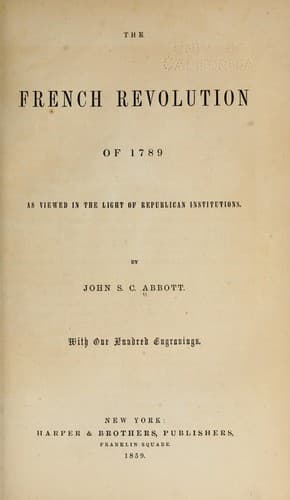
The French Revolution of 1789, as Viewed in the Light of Republican InstitutionsAbbott, John S. C. (John Stevens Cabot)
History
The French Revolution of 1789, as Viewed in the Light of Republican Institutions
Abbott, John S. C. (John Stevens Cabot)
France -- History -- Revolution, 1789-1799
Necker was desirous of introducing some popular element into the
government. There was now a numerous body of men belonging to the
unprivileged class, energetic and enlightened, whose voice ought to
be heard in the administration of affairs as representatives of the
people. He therefore recommended that there should be provincial
parliaments in the different departments of France, somewhat
corresponding with the present legislatures in the United States.
In a few of the provinces there were already parliaments, but they
were composed exclusively of the privileged class. Turgot also had
contemplated provincial legislatures, which he desired to constitute
as the organ of the _people_, and to be composed only of members of
the Tiers Etat.[53] Necker, however, hoped to conciliate the nobles
by giving the privileged body an equal representation with the
unprivileged in these assemblies. One half were to be representatives
of the clergy and the nobility, and the other half of the people,
though the people numbered millions, while the clergy and nobles
numbered but thousands.
Necker's report showed that the interest upon the public debt
absorbed one third of the revenues; that the remaining two thirds
were by no means sufficient for carrying on the government, and that,
consequently, the burden was continually growing heavier by loans and
accumulations.[54] The suggestions of Necker, to give the people a
voice in the administration of affairs and to tax high-born men equally
with low-born, created intense opposition. The storm became too fierce
to be resisted. Both the king and the prime minister yielded to its
violence, and Necker, like Turgot, was driven with contumely from the
ministry and into exile. The hearts of the people followed the defeated
minister to his retreat. These outrages were but making the line which
separated the privileged from the unprivileged more visible, and were
rousing and combining the masses. The illustrious financier, in his
retirement, wrote his celebrated work upon the administration of the
finances, a work which contributed much to the enlightenment of the
public mind.[55] The intellect of the nation was roused, as never
before, to the discussion of the affairs of state. In the parlor, the
counting-room, the work-shop, the farm-house, and the field, all were
employed in deliberating upon the one great topic which engrossed
universal attention. And yet the nobles and their partisans, with
infatuation inexplicable, resisted all measures of reform; a singular
illustration of the Roman adage, "Quem Deus vult perdere priusquam
dementat" (_whom God would destroy he first makes mad_).
Public-domain text, read in full here on John Shaqi.
Reviews
Reviews
No reviews yet
Be the first to share your thoughts on this work.
Elsewhere in the archive
Join the Discussion
Join the discussion
Sign in to leave a comment or review.
Sign InorCreate an account