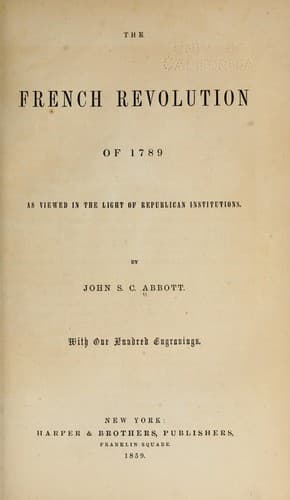
The French Revolution of 1789, as Viewed in the Light of Republican InstitutionsAbbott, John S. C. (John Stevens Cabot)
History
The French Revolution of 1789, as Viewed in the Light of Republican Institutions
Abbott, John S. C. (John Stevens Cabot)
France -- History -- Revolution, 1789-1799
Indeed, the opposition was sufficiently formidable to appal any
minister. There were eighty thousand nobles, inheriting the pride and
prestige of feudal power, with thousands, dependent upon their smiles,
rallying around them as allies. There were the officers in the army,
who were either hereditary nobles or, still worse, men of wealth
who had purchased titles of nobility. There were a hundred thousand
persons who, in various ways, had purchased immunity from the burdens
of state, and were thus within the limits of the privileged class, and
hated by the people, though despised by the nobles. There were two
hundred thousand priests bound by the strongest of possible ties to
the hierarchy, the humble class depending for position and bread upon
their spiritual lords and obliged by the most solemn oaths to obey
their superiors. And these priests, intrusted with the keys of heaven
and of hell, as was supposed by the unenlightened masses, held millions
in subjection by the most resistless powers of superstition. There
were sixty thousand in the cloisters of the monasteries, many of them
dissolute in the extreme, and who were necessarily subservient to the
ecclesiastics. There were the farmers general, the collectors of the
revenue, and all the vast army of office-holders, who were merely the
agents of the court.
"This formidable mass of men," says M. Rabaud de St. Etienne, "were
in possession of all France. They held her by a thousand chains. They
formed, in a body, what was termed _la haute nation_. All the rest was
the people."[56]
Though the privileged class and their dependents, which we have above
enumerated, amounted to but a few hundred thousand, perhaps not five
hundred thousand in all, and the people amounted to some twenty-five
millions, still all the power was with the aristocracy. The mass of the
people were merely slaves, unarmed, unorganized, uneducated. They had
been degraded and dispirited by ages of oppression, and had no means of
combining or of uttering a united voice which should be heard.
Public-domain text, read in full here on John Shaqi.
Reviews
Reviews
No reviews yet
Be the first to share your thoughts on this work.
Elsewhere in the archive
Join the Discussion
Join the discussion
Sign in to leave a comment or review.
Sign InorCreate an account