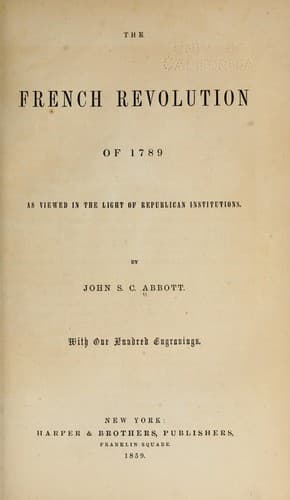
The French Revolution of 1789, as Viewed in the Light of Republican InstitutionsAbbott, John S. C. (John Stevens Cabot)
History
The French Revolution of 1789, as Viewed in the Light of Republican Institutions
Abbott, John S. C. (John Stevens Cabot)
France -- History -- Revolution, 1789-1799
Immediately succeeding M. Necker in the ministry of finance came M.
Fleury and M. d'Ormesson. They were both honest, well-meaning men, but
were promptly crushed by a burden which neither of them was at all
capable of bearing. Their names are hardly remembered. Maurepas was now
dead. The Americans, aided by France, had achieved their independence,
and France and England were again at peace. The king now selected M.
de Calonne from the Parliament, as Minister of Finance. He was a man
of brilliant genius, of remarkably courtly manners, but licentious and
extravagant. The king hoped, by his selecting Calonne, to diminish that
opposition of the Parliament which was daily growing more inveterate
against the crown. For a time the new minister was exceedingly popular.
His high reputation for financial skill and his suavity enabled him
to effect important loans; and by the sale and the mortgage of the
property of the crown he succeeded for a few months in having money
in abundance. The court rioted anew in voluptuous indulgence. The
beautiful palace of St. Cloud was bought of the Duke of Orleans for the
queen, and vast sums were expended for its embellishment. The Palace
of Rambouillet was purchased as a hunting-seat for the king. Marie
Antoinette gave innumerable costly entertainments at Versailles, and
rumor was rife with the scenes of measureless extravagance which were
there displayed. The well-meaning, weak-minded king, having no taste
for courtly pleasure and no ability for the management of affairs,
either unconscious of the peril of the state or despairing of any
remedy, fitted up a work-shop at Versailles, where he employed most
of his time at a forge, under the guidance of a blacksmith, tinkering
locks and keys. This man, Gamin, has recorded:
"The king was good, indulgent, timid, curious, fond of sleep. He
passionately loved working as a smith, and hid himself from the queen
and the court to file and forge with me. To set up his anvil and
mine, unknown to all the world, it was necessary to use a thousand
stratagems."[57]
Public-domain text, read in full here on John Shaqi.
Reviews
Reviews
No reviews yet
Be the first to share your thoughts on this work.
Elsewhere in the archive
Join the Discussion
Join the discussion
Sign in to leave a comment or review.
Sign InorCreate an account