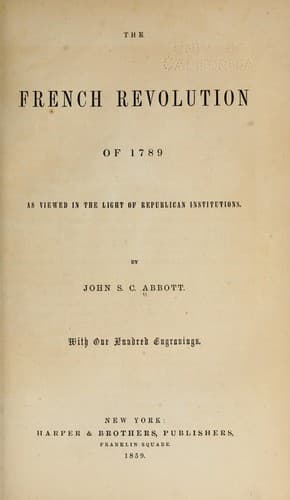
The French Revolution of 1789, as Viewed in the Light of Republican InstitutionsAbbott, John S. C. (John Stevens Cabot)
History
The French Revolution of 1789, as Viewed in the Light of Republican Institutions
Abbott, John S. C. (John Stevens Cabot)
France -- History -- Revolution, 1789-1799
[Footnote 55: "And so Necker, Atlas-like, sustains the burden of
the finances for five years long. Without wages--for he refused
such--cheered only by public opinion and the ministering of his
noble wife. He, too, has to produce his scheme of taxing; clergy,
noblesse to be taxed--like a mere Turgot. Let Necker also depart; not
unlamented."--_Carlyle, French Revolution_, vol. i., p. 46.]
[Footnote 56: M. Rabaud de St. Etienne, vol. i., p. 22.]
[Footnote 57: Memoirs of the Reign of Louis XVI., by the Abbé Soulavie,
vol. ii., p. 191.]
CHAPTER VII.
THE ASSEMBLY OF THE NOTABLES.
Measures of Brienne.--The Bed of Justice.--Remonstrance of
Parliament.--Parliament Exiled.--Submission of Parliament.--Duke
of Orleans.--Treasonable Plans of the Duke of Orleans.--Anxiety
of the Queen.--The Diamond Necklace.--Monsieur, the King's
Brother.--Bagatelle.--Desperation of Brienne.--Edict for abolishing
the Parliaments.--Energy of the Court.--Arrest of D'Espréménil and
Goislard.--Tumults in Grenoble.--Terrific Hail-storm.
The Notables, one hundred and forty-four in number, nearly all
ecclesiastics, nobles, or ennobled, met at Versailles, Jan. 29, 1787.
Calonne expected that this body, carefully selected by the king, would
advise that all orders should make common cause and bear impartially
the burden of taxation. Sustained by the moral power of this advice he
hoped that the measure could be carried into execution. He presented
his statement of affairs. Though he endeavored to conceal the worst,
the Notables were appalled. Three hundred and fifty millions of dollars
had been borrowed within a few years, and the annual deficit was
thirty-five millions of dollars.[58] Cautiously he proposed his plan of
impartial taxation. It was the signal for a general assault upon the
doomed minister. He was literally hooted down. Not only the Assembly of
Notables, but the clergy, the Parliament, the nobles all over the realm
pounced upon him, led even by the queen and the Archbishop of Paris;
and Calonne, without a friend, was compelled to resign his office and
to fly from France.[59]
The clergy were exceedingly exasperated against Calonne, for they
deemed the proposition to tax the possessions of the Church as
sacrilegious. The most active of the opponents of Calonne was Brienne,
Archbishop of Toulouse. He was a bold, resolute, ambitious man, and by
the influence of the queen was appointed to succeed Calonne. "As public
credit was dead," said a wag, "an archbishop was summoned to bury the
remains."[60] The spirit of discontent and of menace was now becoming
every day more extended and alarming, and the Revolution was gaining
strength.
Public-domain text, read in full here on John Shaqi.
Reviews
Reviews
No reviews yet
Be the first to share your thoughts on this work.
Elsewhere in the archive
Join the Discussion
Join the discussion
Sign in to leave a comment or review.
Sign InorCreate an account