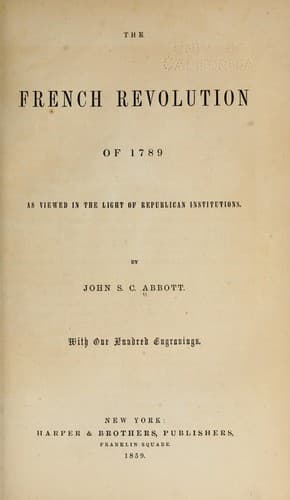
The French Revolution of 1789, as Viewed in the Light of Republican InstitutionsAbbott, John S. C. (John Stevens Cabot)
History
The French Revolution of 1789, as Viewed in the Light of Republican Institutions
Abbott, John S. C. (John Stevens Cabot)
France -- History -- Revolution, 1789-1799
Among the Notables thus assembled there were some warm advocates of
popular liberty. La Fayette was perhaps the most conspicuous of these.
He spoke boldly against _lettres de cachet_ and other abuses. The
Count d'Artois, afterward Charles X., reproved him for this freedom.
La Fayette firmly, yet with caution, responded, "When a Notable is
summoned to speak his opinion he must speak it."[61]
One of the first acts of Brienne was to abolish the Assembly of
Notables.
Their session continued but nine weeks, being dissolved May 25,
1787. He then struggled for a time in the midst of embarrassments
inextricable until he was compelled to propose the same measure which
had already been three times rejected with scorn, and which had driven
three ministers in disgrace from Paris--_the taxing of the nobles_. He
did every thing in his power to prepare the way for the suggestion, and
connected the obnoxious bill with another less objectionable, hoping
that the two might pass together. But the clergy and the nobles were on
the alert.
Two thirds of the territory of the kingdom had been grasped by
the Church and the nobles. One third only belonged to the people.
Brienne proposed a _territorial tax which should fall upon all landed
proprietors alike_. There was an instantaneous shout of indignation
from the whole privileged class, and the cry "Away with him," "Hustle
him out," spread from castle to castle, and from convent to convent.
It was a _custom_, rather than a law, that no royal decree could
pass into effect until it had been registered by Parliament; and it
was a _custom_, rather than a law, that, if the Parliament refused
to register a decree, the king could hold what is called a _bed of
justice_; that is, could summon the Parliament into his presence and
command the decree to be registered. As the king could banish, or
imprison, or behead any one at his pleasure, no Parliament had as yet
ventured to disobey the royal command.
The Parliament declined registering the decree taxing the property of
the clergy and the nobles. The king peremptorily summoned the whole
refractory body to appear before him. It was the 6th of August, 1787.
In a vast train of carriages, all the members, some one hundred and
twenty in number, wheeled out from Paris to the Palace of Versailles.
There the king with his own lips ordered them to register the decree.
Obedient to the royal order it was registered, and the Parliament,
sullen and exasperated, was rolled back again to the metropolis. The
people contemplated the scene in silent expectation, and by thousands
surrounded the Parliament on its return, and greeted them with
acclamations.
Public-domain text, read in full here on John Shaqi.
Reviews
Reviews
No reviews yet
Be the first to share your thoughts on this work.
Elsewhere in the archive
Join the Discussion
Join the discussion
Sign in to leave a comment or review.
Sign InorCreate an account