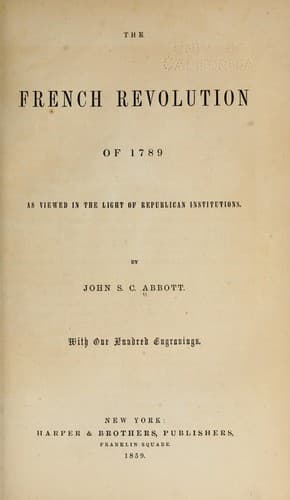
The French Revolution of 1789, as Viewed in the Light of Republican InstitutionsAbbott, John S. C. (John Stevens Cabot)
History
The French Revolution of 1789, as Viewed in the Light of Republican Institutions
Abbott, John S. C. (John Stevens Cabot)
France -- History -- Revolution, 1789-1799
The cold winds of winter were now sweeping over France. All the
industrial energies of the nation were paralyzed. The loss of the
harvest had created a general famine, and famine had introduced
pestilence. Men, women, and children, without number, wandered over the
highways, and by a natural instinct flocked to Paris. The inhabitants
of the city looked appalled upon these multitudes, with haggard faces
and in rags, who crowded their pavements. They could not be fed, and
starving men are not willing to lie down tranquilly and die when they
have strong arms to seize that food which the rich can obtain with
money. The eloquent and impassioned writers of the day had fully
unveiled to the nation the abuses which it had for ages endured, and
yet the people, with wonderful patience and long-suffering, were
quietly waiting for the meeting of the _States-General_, as the only
means for the redress of their grievances.
On the 4th of May, 1789, the States-General were convened at
Versailles. The clergy and the nobility appeared, by royal decree,
magnificently attired in purple robes emblazoned with gold, and with
plumed hats. The deputies of the Third Estate were enjoined to present
themselves in plain black cloaks and slouched hats, as the badge of
their inferiority.[93] On Saturday, the 2d of May, the king gave a
reception, in the magnificent audience-chamber of the palace, to the
delegates. When one of the nobles or of the high clergy presented
himself both of the folding doors were thrown open as his name was
announced; but when one of the Third Estate was presented one door
only was thrown back. This studied indignity was of course annoying
to men who were really the most distinguished in the realm, and who
were conscious of their vast superiority to the corrupt and decaying
aristocracy.[94]
[Illustration: THE THREE ORDERS.]
On the Paris Avenue at Versailles there was an immense hall called the
_Salle des Menus_, which no longer exists. It was sufficiently large to
contain the twelve hundred deputies, and in whose spacious galleries
and wide side-aisles four thousand spectators could be assembled.
It was a magnificent hall, and was ornamented for the occasion with
the highest embellishments of art. Here the king could meet all the
deputies of the three orders. But the nobles and the clergy had
already formed the plan still to keep the power in their own hands by
insisting that the States should meet in three separate chambers and
give three separate votes. Thus three hundred nobles and three hundred
clergy would give two votes, and six hundred of the people but one.
This was the last chance for the privileged class to retain their
domination, and this battle they would fight to desperation. The people
were equally determined not to be thus circumvented. The privileged
class, resolved upon the accomplishment of their plan, had prepared
for themselves two smaller halls, one for the nobility and one for the
clergy.
FOOTNOTES:
Public-domain text, read in full here on John Shaqi.
Reviews
Reviews
No reviews yet
Be the first to share your thoughts on this work.
Elsewhere in the archive
Join the Discussion
Join the discussion
Sign in to leave a comment or review.
Sign InorCreate an account