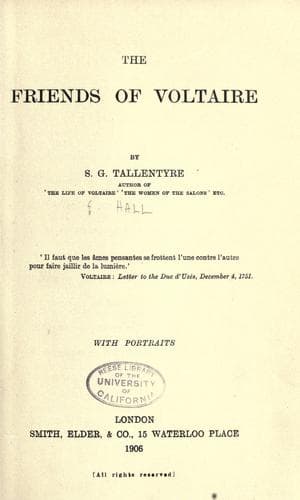
France -- Biography; Voltaire, 1694-1778 -- Friends and associates
Besides these public acts, he was engaged in hundreds of small
individual charities. Among others, he educated at his own expense a
youth whose father had been entirely ruined by taxation and famine. The
youth was Vergniaud, afterwards the stirring orator of the Revolution.
In his home-life Turgot remained most frugal and laborious, treating his
servants with a benevolence then accounted contemptible, and working out
his quiet schemes with an infinite patience and thoroughness. When he
was offered the richer Intendancy of Lyons, he would not take it. Here,
as he said of himself, though he was ‘the compulsory instrument of great
evil,’ he was doing a little good. Only a little, it might be. But if
every man did the little he could--what a different world!
In 1765, he paid a visit to Paris, and in the Calas case, made famous by
Voltaire, spoke on the side of tolerance with a vehemence unusual to
him. Morellet, d’Alembert, and Mademoiselle de Lespinasse were still his
friends. Condorcet was in his closest intimacy, and destined hereafter
to write his Life--‘one of the wisest and noblest of lives,’ says John
Stuart Mill, ‘delineated by one of the noblest and wisest of men.’
In Paris, he met Adam Smith, the political economist. As a result of
their acquaintance Turgot produced in the next year his ‘Reflections on
the Reformation and Distribution of Wealth,’ fertile in conception, arid
in style, and anticipating many of the ideas familiar to English readers
through Adam Smith’s ‘Wealth of Nations.’
But the insistent claims of Limoges on his time and pity narrowed his
hours for study, even for the study that would serve it well. In 1767 he
cleared the province of wolves, by a system analogous to that by which
Edgar rid Wales of the same pest.
Then, in 1770, Limoges and its Intendant began their fight with want.
When Turgot came to the province, the wretched place was a million
francs in arrears for its taxes. Some he had certainly lessened. The
work he had started was just beginning to bear its first little harvest
of good, when there came the withering blast of the two years’ famine.
Its horrors were unthinkable. Turgot wrote to Terrai, the
Controller-General, that it was impossible to extort the taxes and the
arrears without ruin--_ay, and with ruin_--to the taxed. The people
could not only not pay what was demanded of them, but they had nothing
to sell for the barren necessities of their own existence. God knows
they had learnt by long and bitter practice to subsist on little enough!
But now they must surely sit down and die.
Strong and calm, Turgot rose up again. From the Parliament at Bordeaux
he obtained permission to levy a tax on the rich in aid of the
sufferers. He himself opened workshops in which he gave work, and paid
for it, not in coin, which would certainly be spent at the nearest
_cabaret_, but in leather tickets which could be exchanged for food at
the cheap provision shops, also of his own institution.
Public-domain text, read in full here on John Shaqi.
Reviews
Reviews
No reviews yet
Be the first to share your thoughts on this work.
Elsewhere in the archive
Join the Discussion
Join the discussion
Sign in to leave a comment or review.
Sign InorCreate an account