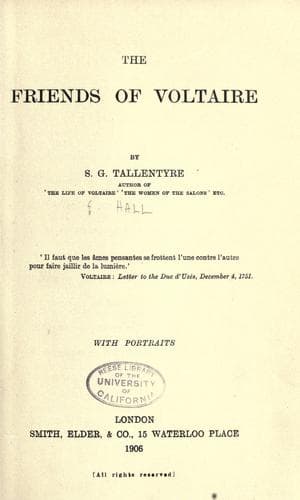
France -- Biography; Voltaire, 1694-1778 -- Friends and associates
A shrill outcry of indignation rang through Versailles. Make us pay!
_Us!_ The Court had always scorned Turgot with his shy, quiet manner,
his gentle aloofness, and the reflection cast, in the most odious taste,
by the purity of his life on its own manner of living. But now it hated
him. Tax _us_! Curtail _our_ extravagances! Reduce _our_ expenditure!
What next? He has already abolished a number of our very best sinecures
and lessened the salaries attached to several enticing little offices
where we were enormously paid for doing nothing gracefully! He has given
posts to persons fitted for them instead of to our noble and incompetent
relations! If one of _us_ (even when one of us is the Duc d’Orléans
himself) wants to do something--well--illegal, he will not allow it! As
though the makers of law could not be its breakers if they chose! And
Versailles rustled indignantly in its unpaid-for silks, whispered,
murmured, connived at the fall of this quiet, strong person who had not
a thought in common with them--nor a thought of himself.
But he had a more dangerous enemy than the Court--the Queen.
Quick-witted, wilful, impetuous, with a husband whose slow, hesitating
intellect she must needs despise, clever enough to love to meddle with
great things, but not wise enough to meddle well--Marie Antoinette took
her first deep step down the stairway of ruin when she chose to be
Turgot’s enemy instead of Turgot’s friend. Could he have saved her too,
if she would have let him, as, but for her, men thought he might have
saved France? God knows. Marie Antoinette wanted to be amused, and her
particular amusement, gambling, was very expensive; she was infinitely
good-natured and impetuously in love at the moment with Madame de
Lamballe, and wanted for her the revival of the old post of
Superintendent of the Household, with its enormous emoluments. And at
her side stood Turgot, saying, ‘No.’ Maurepas had long since deserted
him. It was much easier, and safer for one’s own interest, to give the
Queen what she wanted and have done with it. As for Louis, he was, as
usual, weak with the weakness that brought him to the guillotine and
ended the French monarchy.
Turgot so far controlled him that the six Edicts were registered by the
unwilling Parliament of Paris. Then Monsieur, afterwards Louis the
Eighteenth, expressed in a pamphlet of very feeble wit the feelings of
the upper classes against this terrible reformer. That paltry skit had
already turned the King against his Minister, when Maurepas showed him a
sharp financial criticism on Turgot’s calculations as
Controller-General, and some forged letters purporting to come from
Turgot and containing expressions offensive to the Royal Family. Not man
enough to take them to Turgot and demand explanation, the wretched King
went on distrusting him and giving him feeble hints to resign.
Public-domain text, read in full here on John Shaqi.
Reviews
Reviews
No reviews yet
Be the first to share your thoughts on this work.
Elsewhere in the archive
Join the Discussion
Join the discussion
Sign in to leave a comment or review.
Sign InorCreate an account