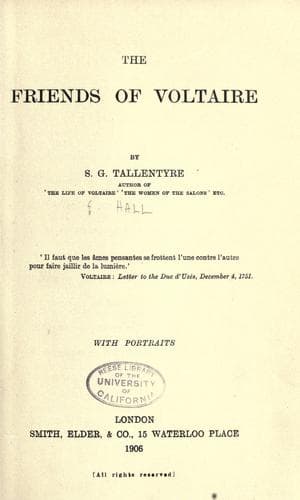
France -- Biography; Voltaire, 1694-1778 -- Friends and associates
Turgot retired quietly into private life. That he was disappointed, not
for himself, but for his country, is very true. True, too, he was
angered at the backstairs policy which had dismissed him. But far
beyond this, there was so much he could have done, which now he could
never do! Faithful to his life-long principle of gathering up the
fragments that remain, he read and studied much, corresponded with Hume
and Adam Smith, often met and talked with Franklin, went to see Voltaire
when he came to Paris in 1778, made experiments in chemistry and
physics, and was active in private benevolence.
Was the brief evening of his life solitary? The one human affection
which, in its perfection, makes loneliness impossible, was not his; or
at best was his only as a dream or a memory. But in the great family of
earth’s toiling children he must have known there were many to love and
bless him, many he had saved from wrong or from sorrow, some whom he had
made from beasts into men. Another blessing was his--he did not long
survive his active labours. He died March 21, 1781, aged fifty-four.
A failure, this life? It may be so; but a failure beside which many a
success is paltry.
Turgot could not save France from her Revolution, but he gave her, and
all countries, practical, working theories on government, on the liberty
of the press, on the best means of helping the poor, on the use of
riches, on civil, political, and religious liberty, which are still
invaluable.
He has been justly said to have founded modern political economy; to
have bequeathed to future generations ‘the idea of the freedom of
industry;’ and to have made ready the way for the reforms which are the
glory of our own day.
Among Voltaire’s fellow-workers there are far more dazzling
personalities. But from their fiery words, exalted visions, and too
glorious hopes one turns with a certain sense of relief to this quiet,
strong, practical man, and understands why the people, whose instinct in
judging the character of their rulers seldom betrays them in the long
run, specially acclaimed Turgot as a friend.
IX
_BEAUMARCHAIS: THE PLAYWRIGHT_
Some men do great things incidentally and unintentionally. Pierre
Augustin Caron de Beaumarchais bothered his clever head scarcely at all
with schemes for the well-being of his country--was little concerned
with humanity and very much with one man--himself. Yet by a special
irony of destiny the author of ‘The Marriage of Figaro’ played one of
the chief parts in the prelude to the drama of the Revolution.
Born in Paris on January 24, 1732, the son of a watchmaker with a large
family, Pierre Augustin Caron early learnt his father’s trade, picked up
a little Latin at a technical school at Alfort and the rest of his
education from experience and from the world.
A lively, impudent, good-looking boy, young Caron was from the first
clever with that smart cleverness which is as distinct from genius or
from wisdom, as kindness is distinct from sympathy
Public-domain text, read in full here on John Shaqi.
Reviews
Reviews
No reviews yet
Be the first to share your thoughts on this work.
Elsewhere in the archive
Join the Discussion
Join the discussion
Sign in to leave a comment or review.
Sign InorCreate an account