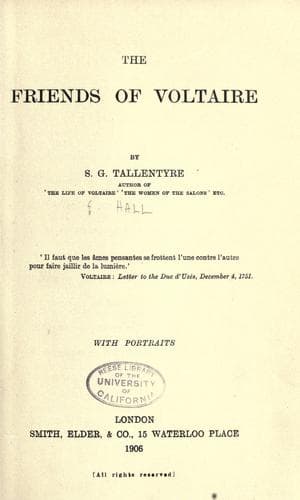
France -- Biography; Voltaire, 1694-1778 -- Friends and associates
The hereditary noble listened to this: ‘Nobility, money, rank, place,
all that makes people so proud! What have you done for so much good
fortune? You have given yourself the trouble to be born;’ and the
_bourgeois_ at his side, to whom merit had opened no path to glory,
heard with a strange thrill Figaro continue, ‘While for me, lost in a
crowd of nobodies, I have had need of more knowledge and calculation
simply to exist, than has been employed to govern all the Spains for a
hundred years.’
Did the Minister who had filled the snug posts in the Government with
his own relations and friends see nothing but a joke in: ‘They thought
of me for a situation, but unluckily I was fit for it; they wanted an
accountant; a dancer obtained the place’? ‘Intelligence a help to
advancement? Your lordship is laughing at mine. Be commonplace and
cringing, and you can get anywhere.’ ‘To succeed in life, _le
savoir-faire vaut mieux que le savoir_.’
The ubiquitous Englishman of the audience heard Figaro announce ‘Goddam’
to be ‘the basis of the English language.’ The political world listened
to a scathing definition of diplomacy: ‘To pretend to be ignorant of
what everyone else knows, and to know what everyone else does not know
... to seem deep when one is only empty and hollow ... to set spies and
pension traitors ... to break seals and intercept letters ... there’s
diplomacy, or I’m a dead man.’
The audience trooped out into the night--the performance lasted from
half-past five till ten--with enthusiastic admiration on its lips and
still ringing in its ears the seventh couplet of the vaudeville:
Par le sort de la naissance,
L’un est roi, l’autre est berger;
Le hasard fit leur distance;
L’esprit seul peut tout changer.
The writer, certainly, had as little idea as his audience that his was
to be the wit to change everything. From first to last, Beaumarchais was
the man we have always with us, who means to advance in the world and
let that world take care of itself; whose argument is that posterity
having done nothing for him, he need do nothing for posterity; the true
time-server, just audacious enough to say what less courageous people
only dare to think, and earning thereby their gratitude and applause.
Caron had reaped place and fortune from the old order, and was not at
all minded to overthrow it. Tyranny for tyranny, he preferred the
despotism of the King to the despotism of the mob. If he revenged
himself in his play for the slights and humiliations from which even
his cleverness had not been able to save him--that was absolutely all.
Overturn Throne and Church! Such a _bouleversement_ would very likely
overturn Caron de Beaumarchais too, and was not to be thought of.
Public-domain text, read in full here on John Shaqi.
Reviews
Reviews
No reviews yet
Be the first to share your thoughts on this work.
Elsewhere in the archive
Join the Discussion
Join the discussion
Sign in to leave a comment or review.
Sign InorCreate an account