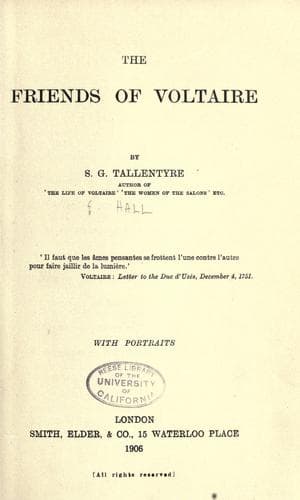
France -- Biography; Voltaire, 1694-1778 -- Friends and associates
Since he never gave himself blindly to any one faction, all factions
have distrusted and condemned him. To the Royalist he is a
Revolutionist; to the Revolutionist he is an aristocrat. The thinker
cannot forgive him that his thought led him to deeds and words; the man
of action cannot forget that he was thinker and dreamer to the end.
While the Church can never pardon his persistent hostility to theology,
his vehement opposition to Roman Catholicism, as the religion ‘where a
few rogues make many dupes,’ the unbeliever is impatient with his serene
faith in human kind, his unshattered trust in the goodness, not of God,
but of man.
Far in advance of his time--in some respects of our time too--in his
views on the rights of men and of women, on the education of children,
and in his steady abhorrence of all limitation of what Voltaire called
‘the noble liberty of thinking,’ he is still condemned for an
unpractical idealism, and for his passionate conviction that all errors
are the fruit of bad laws.
But he at least stands out clearly to any impartial observer as one of
the very few whose lofty disinterestedness came unscorched through the
fire of the Terror.
In private life, stern to duty and yet tenderer than any woman in his
quiet, deep affections, patient and strong with the fine endurance of
steel and with the capacity (that capacity which is as rare as genius)
for the highest form of human love, he showed a great character beside
which even his great intellect seems a small thing and a mean.
In the breadth and the generosity of his self-sacrifice for the public
good, he remains for ever one of the noblest, not only of the Friends of
Voltaire, but of the sons of France.
INDEX
‘Advance, The, of the Mind of Man’ (Turgot), 208
‘Advantages, The, of Christianity’ (Turgot), 208
‘Advice of a Proscribed Father, The’ (Condorcet), 291
Aine, Madame d’, 54, 123, 131, 132, 136
Alembert, Jean Lerond d’, 45, 47, 72, 124-5, 133, 136,
199, 213, 269, 271, 275;
birth and parentage, 2-4;
at Madame Rousseau’s, 4-6;
education, 6-8;
mathematical studies, 8-9;
publishes ‘Treatise on Dynamics’ and ‘Theory of Winds,’ 10;
death of his mother, 10;
acquaintance with Diderot, 11;
writes ‘Preface’ to Encyclopædia, 12-13;
offered Presidency of Berlin Academy, 13-14;
member of the French Academy, 14;
visits Voltaire, 15;
writes ‘Geneva,’ 15-16;
retires from Encyclopædia, 16-17;
publishes ‘Elements of Philosophy,’ 17;
visits Berlin, 18;
his attachment to Mlle. de Lespinasse, 18-23;
their _salon_, 23-24;
publishes ‘History of the Destruction of the Jesuits,’ 25;
second visit to Voltaire, 25-26;
made Perpetual Secretary of Academy, 26;
illness and death of Mlle. de Lespinasse, 27-23;
his unhappiness and death, 29-30;
his work and character, 30-31
‘Appeal to the French Citizens’ (Condorcet), 284-5
Argental, Comte d’, 113
Artois, Comte d’, 253, 262
‘Banise’ (Grimm), 152
Public-domain text, read in full here on John Shaqi.
Reviews
Reviews
No reviews yet
Be the first to share your thoughts on this work.
Elsewhere in the archive
Join the Discussion
Join the discussion
Sign in to leave a comment or review.
Sign InorCreate an account