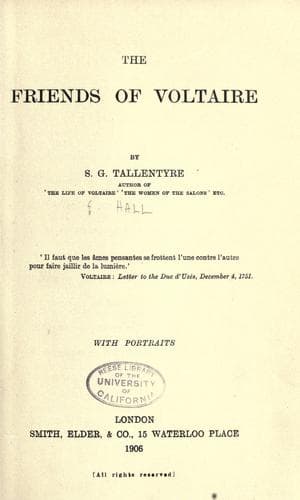
France -- Biography; Voltaire, 1694-1778 -- Friends and associates
Grimm’s _chère amie_, Madame d’Épinay, sometimes accompanied him. Her
sister-in-law, Madame d’Houdetot, often drove down to Grandval with her
superb Marquis de Saint-Lambert in her train. Pitted deeply with the
smallpox, with a cast in her eye, and a little given to too much wine,
the secret of Madame d’Houdetot’s charm is hard to be found by this
generation. But in that one, it was not only Rousseau who discovered it
to his cost. Saint-Lambert’s ‘faith unfaithful kept him falsely true’ to
her for so many years that it came to be considered quite praiseworthy,
and he would have been admitted to Grandval as Madame d’Houdetot’s
constant lover, if his passion for Madame du Châtelet and his poem on
the ‘Seasons’ had not given him the _entrée_ as a literary character as
well.
His rival, Jean Jacques Rousseau, was also an _habitué_ at d’Holbach’s.
The peaceful Baron could agree even with that fretful child of genius,
until one unlucky day, when, Grandval having suffered gladly and
politely a curé’s reading of his own stupid tragedy, Jean Jacques
bounces furiously out of his armchair, seizes the manuscript from its
author, and throws it to the ground--‘Do you not see these people are
laughing at you? Go back to your curacy.’ The kindliest and politest of
hosts tries to smooth the ruffled plumage of both playwright and
Rousseau. If the curé was appeased is not a matter of moment. Jean
Jacques burst out of the house in a rage, and despite all the efforts
of Grimm and of Diderot, as well as of d’Holbach himself, never returned
to it. ‘He imagined all his misfortunes our doing ... and thought we had
incited ... all Europe against him,’ says Grimm. He did try, however, to
make some amends to his good host by portraying him in the ‘New Éloïsa’
in the character of Wolmar--‘benevolent, active, patient, tranquil,
friendly, and trustful.’
Marmontel came here very often: and that dreadful, garrulous old bore,
the Abbé Raynal, was constantly to be found seeking ideas among the
Baron’s guests for his ‘History of the Two Indies,’ which received, and
did not deserve, the advertisement of burning.
The cautious Buffon soon edged away from this _salon_, as he also edged
away from the gatherings of Helvétius. The monstrous things these people
talk about might come to the ears of the authorities--accompanied by the
fact that the politic author of the ‘Natural History’ was among the
talkers! Helvétius himself was often at d’Holbach’s, until the storm of
fury and hatred which assailed his book ‘On the Mind’ banished him,
astounded and embittered, to his estates in Burgundy.
Madame Geoffrin, with her prim little cap tied under her firm old chin,
drove down to play picquet with the Baron and to scold Diderot for
neglecting his wife.
It was partly owing to the influence of Diderot--himself greatly bitten
by the Anglomania just creeping into fashion--that the Baron entertained
Englishmen so largely both in Paris and in the country.
Public-domain text, read in full here on John Shaqi.
Reviews
Reviews
No reviews yet
Be the first to share your thoughts on this work.
Elsewhere in the archive
Join the Discussion
Join the discussion
Sign in to leave a comment or review.
Sign InorCreate an account