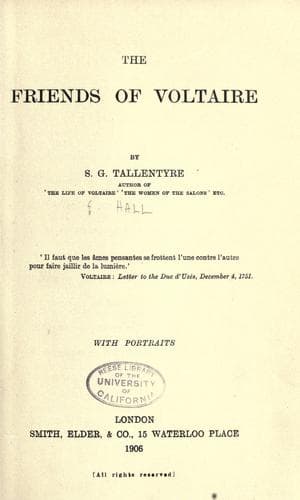
France -- Biography; Voltaire, 1694-1778 -- Friends and associates
In the years 1762-64-66 Sterne accepted the hospitality of the host,
whom he called ‘the great protector of wits and the _sçavans_ who are no
wits,’ to so large an extent that he could say the Baron’s house was as
his own. To be sure, d’Holbach’s ‘joyous sett’ must have admirably
suited this Parson Yorick, who had ‘no religion but in appearance,’ and
a domestic morality very little better than the worst of the Baron’s
French _convives_.
The ‘broad, unmeaning face’ of Hume, the historian, was sometimes to be
seen at d’Holbach’s table, where he found himself for the first time
with thinkers not too narrow, but too emancipated, for his liking. It
was the Baron who, speaking from experience, warned Hume against
nourishing in his bosom a serpent like Rousseau, and from d’Holbach’s
house, says Hume’s biographer, Burton, that the story of the famous
quarrel between Hume and Rousseau spread all over France ‘in a moment.’
David Garrick came to Grandval, and delighted an age and a company
passionately devoted to histrionic talent. A sprightly Madame Riccoboni
used to write accounts of d’Holbach’s society to the actor when he had
gone back to England; and whenever she saw the Baron looked bored or
worried, made that expression a text on which to moralise on the
worthlessness of riches.
The Baron did not often appear anything but placid, however, and there
are very few of his guests who even hint at anything in himself or his
gatherings which was not smooth and delightful.
Horace Walpole, indeed, talks of ‘dull d’Olbach’s.’ But then Horace was
the intimate friend of Madame du Deffand, who loathed ‘les philosophes’
and all their ways and works, and on one occasion at least was so
unlucky as to find himself at one of the Baron’s dinner parties, not
only the solitary Englishman out of a party of twelve, but next to that
tedious Raynal. ‘I dreaded opening my mouth in French before so many
people and so many servants,’ says Horace; and to avoid being bored by
the ‘Two Indies,’ he made signs to Raynal that he was deaf. After
dinner, Raynal discovered the trick, and naturally was not pleased.
John Wilkes, with his ugly face, his flaming past, and his irresistible
charm, also sat at the Baron’s cosmopolitan board; as did Benjamin
Franklin, Lord Shelburne, and Priestley--Non-conformist, chemist, and
one of the founders of modern scientific criticism.
Some of these people, of course, only dined, or were merely invited to
spend a long day in the Grandval grounds and gardens; but many became
part of the house party for days, like Galiani, for weeks, like Grimm,
for months, like Diderot, or for ever, like Father Hoop.
Public-domain text, read in full here on John Shaqi.
Reviews
Reviews
No reviews yet
Be the first to share your thoughts on this work.
Elsewhere in the archive
Join the Discussion
Join the discussion
Sign in to leave a comment or review.
Sign InorCreate an account